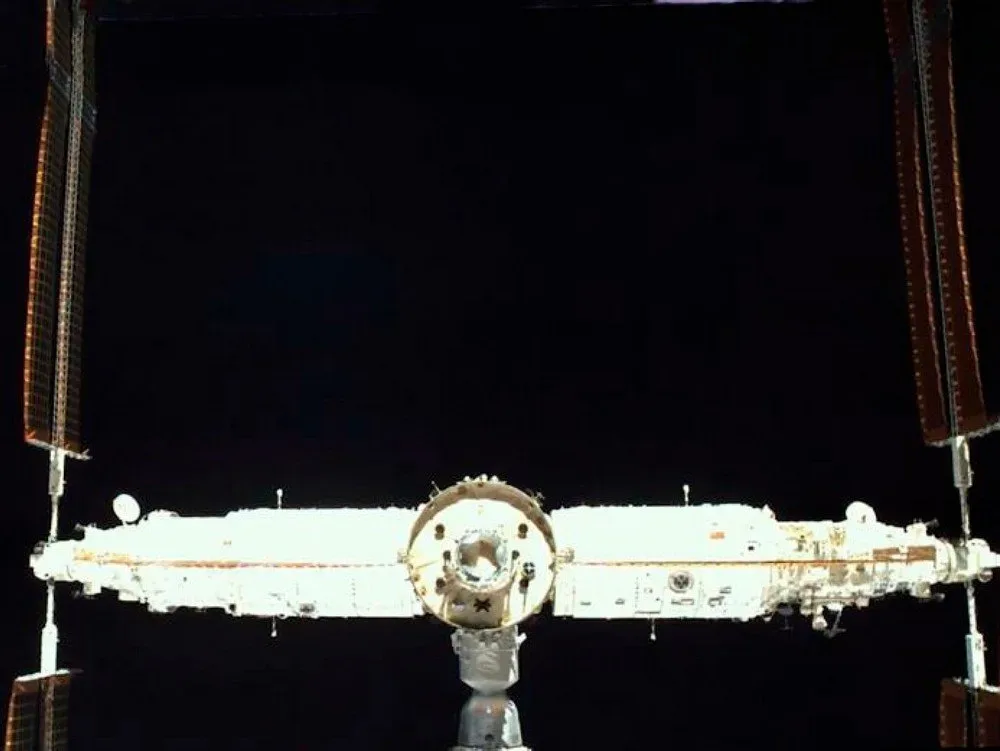
Muhammad Zeeshan Ali, 40, became the first Pakistani astronaut in orbit when he docked with China's Tiangong space station on 25 November 2026, according to Al Jazeera citing Reuters. He is also the first foreign national to board it, on a stay of five to 10 days.
Table of contents 6 sections
- Muhammad Zeeshan Ali docked with China's Tiangong space station on 25 November 2026, per Al Jazeera citing Reuters.
- He is the first Pakistani in orbit and the first foreign national to board the station.
- His stay is reported at five to 10 days, against about six months for Chinese astronauts.
- Pakistan's space agency SUPARCO said he will handle four research payloads picked from more than 300 proposals.
- Beijing wants to show Tiangong can serve as an international research platform, Al Jazeera reports.
The first Pakistani astronaut, Muhammad Zeeshan Ali, docked with China's Tiangong space station in the early hours of Wednesday, 25 November 2026, according to Al Jazeera, citing Reuters. Ali, 40, is the first person from Pakistan to go into orbit and the first foreign national to board the Chinese station. He is one of three crew members on China's Shenzhou-24 spacecraft, which lifted off from the Jiuquan Satellite Launch Centre in northwest China on a Chinese-made rocket.
How long will the first Pakistani astronaut stay on Tiangong?
Al Jazeera reports that Ali will stay for five to 10 days. That is far shorter than the roughly six-month tours that Chinese astronauts usually serve. Before the launch, Space.com described the stay as roughly one week, and said Ali would fly as a payload specialist alongside two Chinese colleagues.
The same report said the return trip would be on the departing Shenzhou-23 spacecraft, together with two Chinese astronauts who have finished a six-month stay. That arrangement was described before launch, and the sources opened for this article do not confirm a return date.
Why does this mission break China's usual crew pattern?
Space.com notes that the flight departs from China's usual "three in, three out" rotation. One Shenzhou-23 astronaut, who arrived on 24 May, will stay on and complete what the article calls China's first year-long stay in orbit. The Shenzhou-23 crew was nearing 180 days in orbit at the time of that report.
The mission has been public for less than three weeks. China's human spaceflight agency confirmed on 7 November that Shenzhou-24 would carry a Pakistani payload specialist, as Al Jazeera reported at the time. China did not name the astronaut then. Pakistani press reports had named two military pilots, Ali and Khurram Daud, as the candidates, chosen from about 20 finalists according to Space.com, and the other candidate was to serve as backup.
What will the astronaut do in orbit?
According to Space.com, Pakistan's space agency SUPARCO said Ali will handle four research payloads, picked from more than 300 proposals. The article describes the chosen experiments as biotechnology projects aimed at food insecurity and climate change.
Ali trained for months in China, including lessons in Chinese, and Al Jazeera notes that most of the mission's infrastructure is Chinese. Speaking to reporters on Tuesday, he said: "I'm not flying for myself. I carry the name of Pakistan on my shoulder."
What have the two governments said?
Pakistani Prime Minister Shehbaz Sharif, in a post on X, called the flight the journey of "240 million Pakistanis" and said it was "living proof of the ironclad friendship between Pakistan and China." Chinese President Xi Jinping described the joint mission as "a vivid embodiment of the deep-rooted friendship between the two countries," per Al Jazeera.
China's Foreign Ministry spokesperson Guo Jiakun said on 9 November that having the Pakistani astronaut on board would mark the first joint mission of Chinese and foreign astronauts, Space.com reported. The programme grew out of an agreement reached in Islamabad in February 2025, according to Space.com, after which two Pakistani candidates trained in Beijing.
Al Jazeera reports that the flight fits Beijing's wish to show that Tiangong can serve as an international research platform rather than an exclusively Chinese facility. Its 7 November piece adds that the flight is part of bilateral cooperation under the Belt and Road Initiative, that China is Pakistan's largest trading partner, and that Pakistan's first lunar rover, Jinnah-1, which weighs 35 kg, is also due to be deployed by the China National Space Administration.
Where does it fit in the Moon race?
Al Jazeera places the flight against a wider contest. China aims to land an astronaut on the Moon by 2030, and plans a Moon research base with Russia by 2035. The United States aims to land astronauts in 2028, its first crewed lunar landing since Apollo 17 in 1972. Readers who want the American side can read our piece on NASA's accelerated 2028 Moon landing plan.
Both governments say their space activities are entirely peaceful, Al Jazeera reports. It adds that the United States has warned that China could seek to dominate resource-rich areas of the Moon. That is Washington's stated concern, and the articles opened for this piece do not include a Chinese response to it.
What to watch next
Several things remain open. The sources opened for this article do not confirm which spacecraft Ali will use to come home, or on what date. Watch for the China Manned Space Agency's statements on his return and on the experiments he carries, and for any word on further foreign astronauts on Tiangong. Official Pakistani and Chinese announcements will settle the details that early coverage left open. Readers following the wider space race may also want our report on NASA's search for partners on a Moon nuclear reactor, since Al Jazeera's 7 November piece also mentions lunar reactor plans on the American and Russian-Chinese sides.


0 comments
No comments yet — be the first.