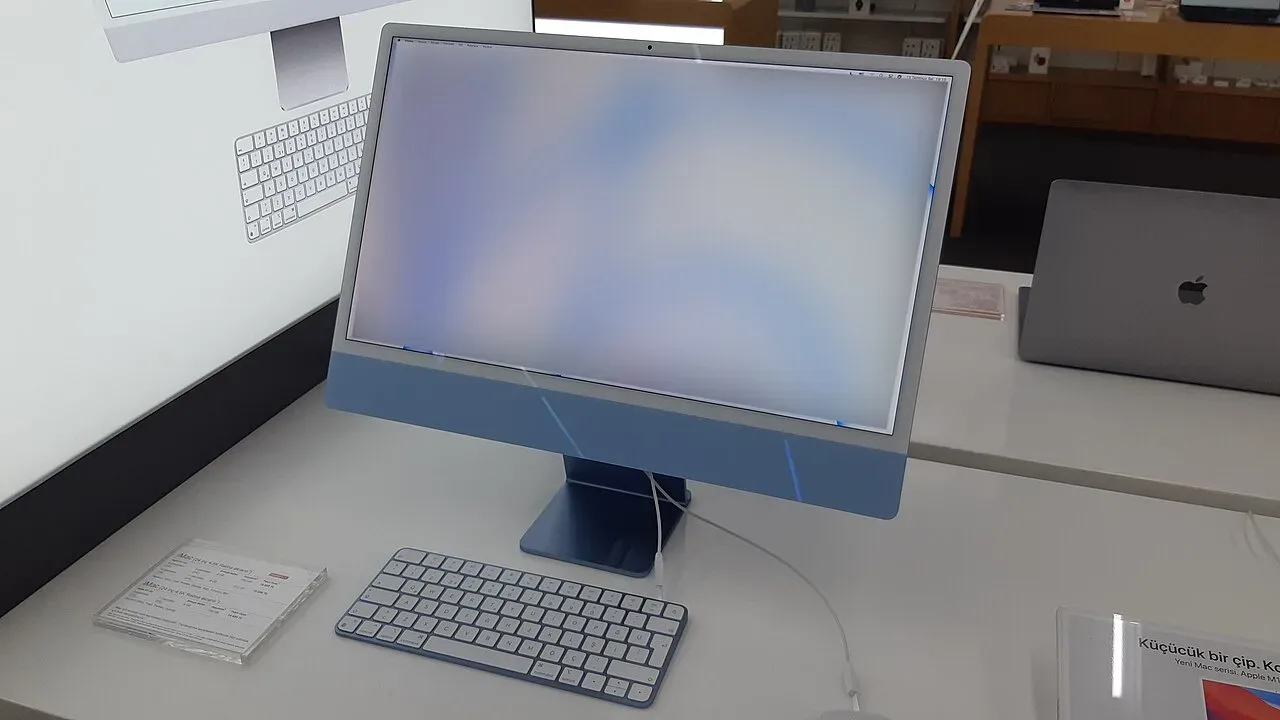
Apple announced the M6 iMac and a 14-inch M6 MacBook Pro on 27 October 2026. The iMac starts at $1,499 and the MacBook Pro at $1,999 in the US. M6 adds two CPU and two GPU cores over M5, and both Macs go on sale on 6 November with unchanged designs.
Table of contents 5 sections
- Apple launched the M6 iMac and 14-inch M6 MacBook Pro on 27 October 2026, with sales from 6 November.
- The M6 chip has a 12-core CPU and 12-core GPU, two more cores of each than M5.
- Apple claims up to 30 percent faster graphics and 25 percent faster on-device AI than M5.
- The iMac starts at $1,499 and the 12-core model at $1,699; the MacBook Pro starts at $1,999.
- Owners of M4 or M5 Macs gain little, while Intel Mac owners see the biggest jump.
Apple put its M6 chip into two Macs on 27 October: a 24-inch M6 iMac starting at $1,499 and a 14-inch MacBook Pro starting at $1,999. Both opened for preorder on 28 October and go on sale on Friday 6 November, and neither changes shape. This is a chip-and-wireless update to designs buyers already know.
It also arrived one day before Apple's touchscreen MacBook Pro, which makes the M6 laptop the value pick of the week by a wide margin. The interesting question is less what M6 does and more who actually needs it.
What is new in the M6 chip?
According to Apple's MacBook Pro announcement, M6 has a 12-core CPU and a 12-core GPU, two more cores of each than M5, plus a Neural Accelerator in every GPU core, a third-generation ray-tracing engine and a dual 16-core Neural Engine. Memory bandwidth reaches 170GB/s.
Apple's headline claims against M5 are up to 30 percent faster graphics, up to 25 percent faster on-device AI work such as processing prompts for a local language model, and a Neural Engine up to 1.9 times faster. Apple did not state the manufacturing process. As always, these are Apple's own benchmarks, and independent testing will tell how much of that shows up in everyday apps.
The AI numbers are aimed at people running models locally rather than in the cloud, a use that grows as AI chatbots and agents move onto personal machines.
M6 iMac: same look, more cores and ports
The M6 iMac keeps its 24-inch 4.5K Retina display at 500 nits and its seven colours: blue, green, pink, yellow, purple, orange and silver. Two configurations matter:
- $1,499: 10-core CPU and 10-core GPU. The Gadgeteer reports 256GB of base storage.
- $1,699: 12-core CPU and 12-core GPU, four Thunderbolt 4 ports, 2.5Gb Ethernet and the option of a nano-texture screen.
Both get Wi-Fi 7 and Bluetooth 6 and can drive up to two 6K external displays. In its iMac release, Apple says the new model is up to 18 times faster than the most popular Intel-based iMac and up to five times faster than M4 in on-device AI. Shelly Goldberg, Apple's vice president of Hardware Engineering, called the iMac "the world's best all-in-one."
The split between the two M6 iMac models is the real story. The extra $200 buys more than two cores: it also brings the Ethernet upgrade, the extra ports and the matte screen option. For a family desktop the base M6 iMac is fine. For anyone who plugs in drives and a dock, the 12-core version is the one to price.
14-inch M6 MacBook Pro: the sensible MacBook Pro
The laptop keeps its Liquid Retina XDR display, rated at up to 1,600 nits peak HDR brightness, with an optional nano-texture finish. Memory starts at 16GB and goes to 32GB. The Gadgeteer lists the base model with a 1TB SSD.
Battery life is rated at up to 24 hours, which Apple calls the longest ever in a Mac, and performance is the same plugged in or on battery. Fast charging reaches 50 percent in about 30 minutes with a 96W or higher adapter. Ports are HDMI, MagSafe 3, three Thunderbolt 4, an SDXC slot and a headphone jack. It comes in space black and silver, and it is built with 45 percent recycled content.
Compare that with the touchscreen PROLED model announced on 28 October, which starts at $2,899, uses M5 Pro or M5 Max and moves to Thunderbolt 5. The M6 model has the newer base chip but fewer high-end features. For students, developers and writers, it is the better buy by $900.
Should you upgrade to an M6 Mac?
It depends on what you have now.
- Intel iMac or MacBook Pro: yes, if your budget allows. Apple's 18x figure is a best case, but the jump from Intel is large by any measure, and macOS support for older Intel machines will not last forever.
- M1 or M2 Mac: worth a look if you run local AI tools, edit video or game. Apple claims up to 11 times faster graphics than the 13-inch M1 MacBook Pro.
- M4 or M5 Mac: probably not. A 25 to 30 percent gain rarely changes daily work, and Wi-Fi 7 alone is no reason to spend $1,500.
One caution on configuration: memory and storage are fixed at purchase, and both have become more expensive across the industry this year. Buying the base 16GB laptop and hoping it lasts five years of AI-heavy apps is a gamble.
What to watch before 6 November
Independent benchmarks should appear in the days before the 6 November release, and they will show whether M6's 30 percent graphics gain holds outside Apple's chosen tests. Watch also for the higher-end M6 Pro and M6 Max chips, which Apple has not announced; until they arrive, Apple's top laptops will keep running a chip generation behind its cheapest MacBook Pro. If you are buying for school or work, education pricing cuts $50 to $100 off these models, and Apple Upgrade leasing starts at $28.99 a month for the iMac in the US.
Frequently asked
- Apple introduces the new 14-inch MacBook Pro with M6 — Apple Newsroom
- Apple unveils new iMac with M6 — Apple Newsroom
- 10 Gadgets That Caught Our Attention in October 2026 — The Gadgeteer


0 comments
No comments yet — be the first.