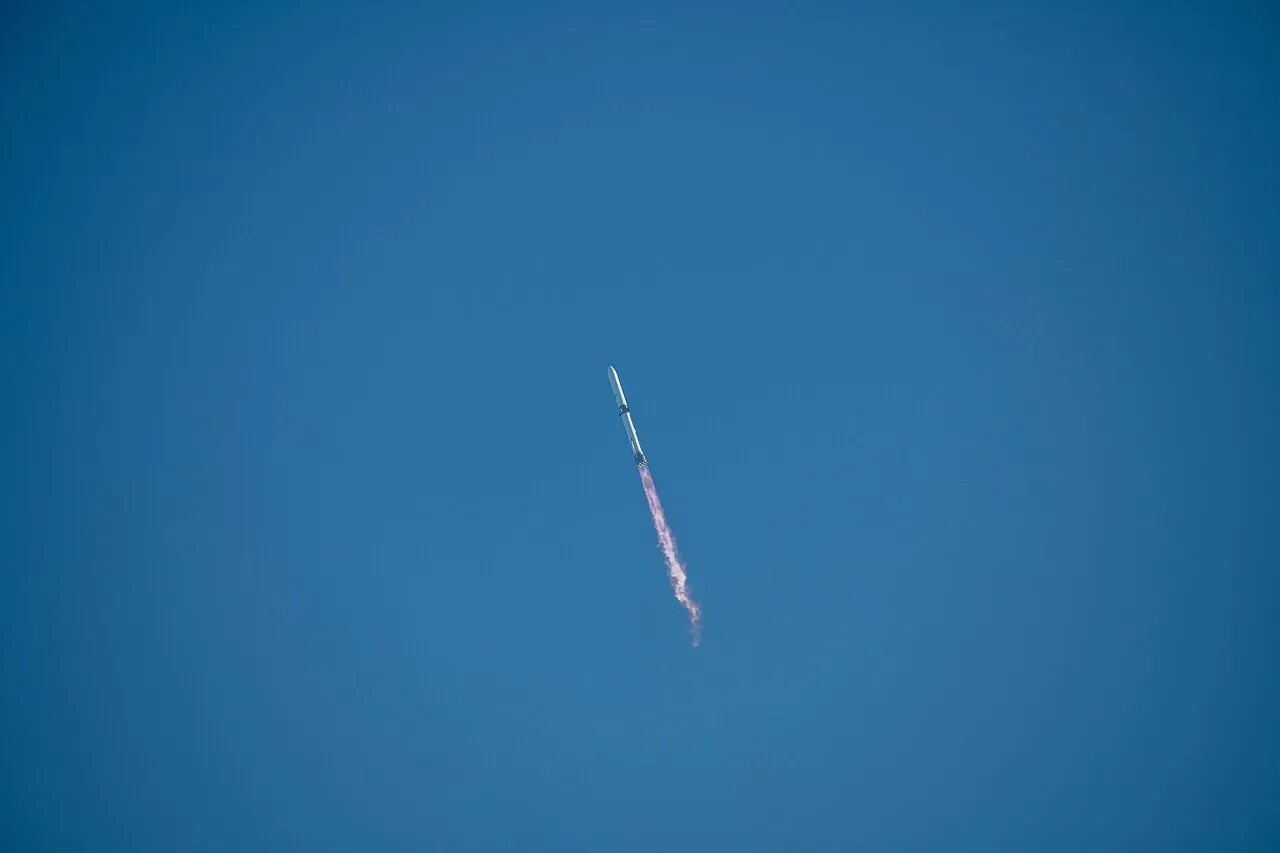
NASA's twin ESCAPADE spacecraft completed powered Earth flybys on 7 and 9 November 2026 and are now cruising to Mars. Each fired its engine for about nine minutes during the pass. Mars orbit insertion is planned for 7 and 9 September 2027, with science operations expected from June 2028.
Table of contents 6 sections
- Both ESCAPADE spacecraft completed powered Earth flybys on 7 and 9 November 2026, according to NASA.
- NASA says it is the first time the agency has used a powered Earth flyby to send a spacecraft toward Mars.
- Each spacecraft fired its engine for about nine minutes at an altitude of roughly 1,000 miles and 650 miles.
- Mars orbit insertion is planned for 7 and 9 September 2027 after a cruise of about 10 months.
- Science operations are expected to begin in June 2028.
The ESCAPADE Earth flyby is done. NASA announced on 9 November 2026 that both of its twin ESCAPADE spacecraft have completed powered passes of Earth and are now on their way to Mars, with orbit insertion planned for September 2027.
The first spacecraft reached its closest approach around 5 a.m. EST on Saturday 7 November. The second followed around 6 a.m. EST on Monday 9 November. Each fired its engine for about nine minutes during the pass, the burn that commits a spacecraft to a path toward Mars.
What happened during the ESCAPADE Earth flyby?
A powered flyby combines two sources of speed. Earth's gravity bends the spacecraft's path and adds energy, and a well-timed engine burn near Earth makes that boost count for more. NASA says the first spacecraft fired at an altitude of about 1,000 miles and the second at about 650 miles.
Asal Naseri, acting associate flight director for NASA's Heliophysics Division, said it was the first time the agency has used a powered Earth flyby to send a spacecraft toward Mars. Jeff Parker, lead mission designer at Advanced Space, said the method allows a launch almost anytime and then uses Earth's gravity to get a boost to Mars.
How does a powered flyby work in practice?
The spacecraft returned to Earth on a path that brought them back close to the planet, at about 1,000 miles up for the first and 650 miles for the second. At closest approach each one fired its engine for roughly nine minutes. Burning deep in Earth's gravity well is efficient, because the same push changes the spacecraft's speed more there than it would far away. NASA calls the result a trans-Mars injection, and the spacecraft now follow a path that meets Mars in September 2027.
The two flybys came two days apart, which also means the two spacecraft will arrive at Mars two days apart. The insertion burns, about 11 minutes each, are the next big engine events.
Why did the probes wait a year near Earth?
The spacecraft launched on 13 November 2025 from Cape Canaveral Space Force Station in Florida. At that time Earth and Mars sat on opposite sides of the Sun, which is a poor arrangement for a direct trip. Instead of waiting for the next standard launch window, the mission sent both spacecraft into a loiter orbit around the Sun-Earth Lagrange point 2, about 1 million miles from Earth.
They stayed there for a year, and then came back for the flybys at a time when the geometry of the two planets suited the trip. The approach trades speed for flexibility. The extra year of waiting is the price, and in return the launch did not have to be timed to a Mars window, as Parker described.
When will ESCAPADE reach Mars?
NASA says the cruise to Mars will take about 10 months. Mars orbit insertion burns, each about 11 minutes long, are planned for 7 September 2027 for the first spacecraft and 9 September 2027 for the second.
Science operations are expected to begin in June 2028. The campaign has a second phase that starts about six months later and is scheduled to last five months. Those dates come from NASA's flyby update and could shift if the spacecraft need further correction burns.
What will ESCAPADE study at Mars?
The mission uses two spacecraft so they can observe the Martian environment at the same time from different places. Principal investigator Rob Lillis of the University of California, Berkeley said it will be the first time scientists can make coordinated observations of the Martian environment. A single orbiter cannot separate changes over time from changes over location, and a pair can.
NASA's flyby page describes ESCAPADE as a heliophysics mission, which means it studies how the Sun's output interacts with planetary surroundings. The agency's update does not list detailed science results because the spacecraft have not yet reached Mars, so anything beyond the objectives above is still ahead.
Most Mars missions launch on a direct path during a window that opens roughly every 26 months. The ESCAPADE route is slower but gave the project a different kind of schedule freedom. NASA is also tracking another planetary arrival soon, covered in our BepiColombo Mercury orbit insertion report, and the Mars surface effort continues with the Perseverance driving record.
The flyby also shows how the number of rocket types and trajectories for deep space has widened. A mission that once needed a perfect launch day can now use a loiter orbit and a gravity assist, and engineers can plan around it. Whether that approach is reused will depend on how the spacecraft perform at Mars in 2027 and 2028.
What to watch next
Watch for NASA's confirmation of the spacecraft's trajectory after the burns, any course corrections during the 10-month cruise, and the two orbit insertion dates in September 2027. The full details of the flyby are in NASA's flyby announcement.

0 comments
No comments yet — be the first.