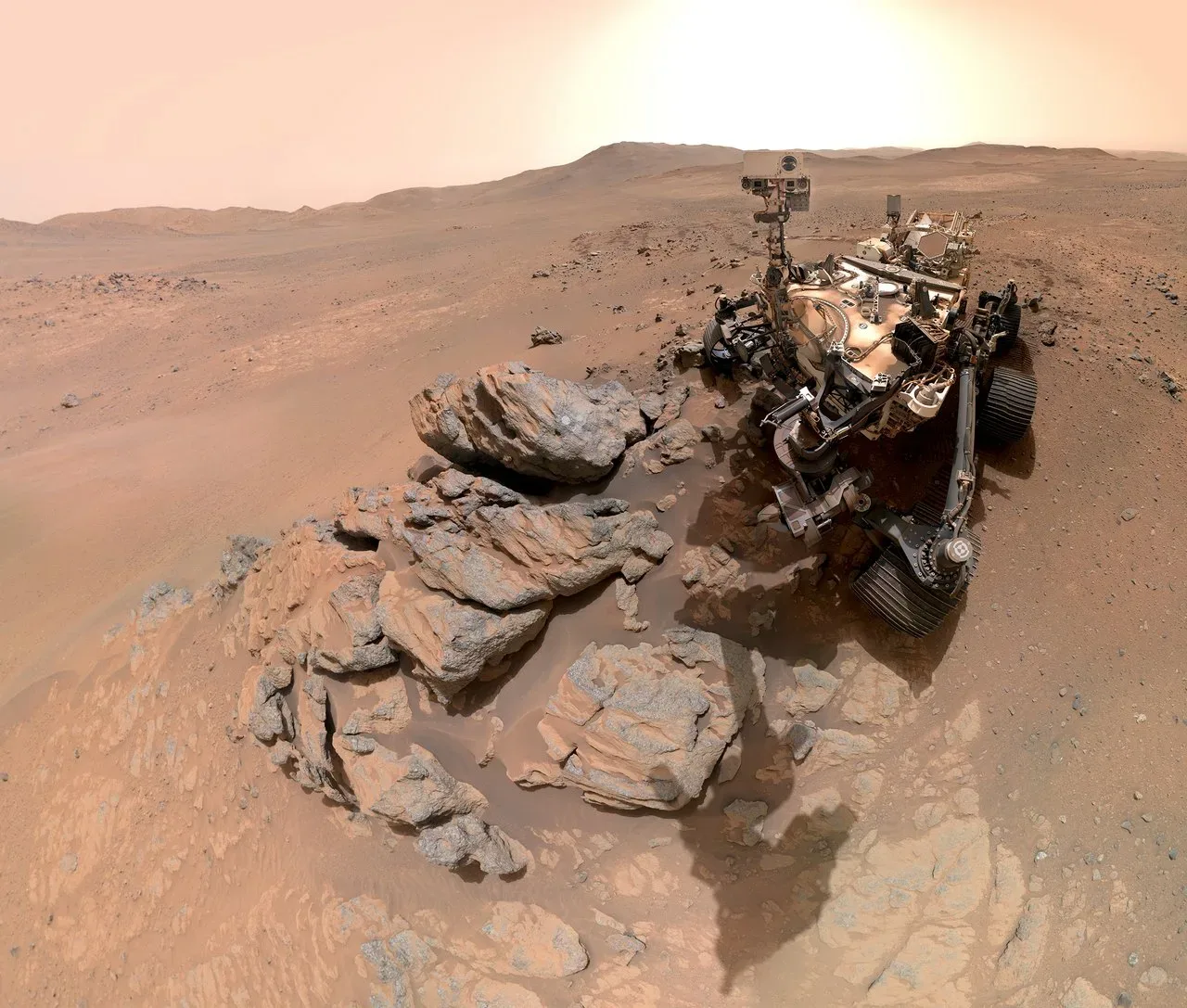
On 11 October 2026 NASA's Perseverance rover reached 45.22 km (28.10 miles) on Mars, passing Opportunity's 45.16 km to set the record for the longest distance driven on another world. It took about five and a half years, against Opportunity's almost 15, largely thanks to the AutoNav self-driving system.
Table of contents 5 sections
- Perseverance reached 45.22 km on 11 October 2026, beating Opportunity's off-world driving record of 45.16 km.
- It took about five and a half years, compared with almost 15 years for Opportunity.
- More than 90 percent of the distance used AutoNav, versus about 5 percent for Spirit and Opportunity.
- The mission was originally required to drive no more than 12.4 miles, about 20 km.
- NASA has extended the mission to about the end of 2028, with Idubi and Rainbow Falls as next targets.
The new Perseverance rover record is official: NASA's Mars rover has driven farther than any vehicle on any world other than Earth. On 11 October 2026, the mission's 2,006th Martian day, its odometer reached 45.22 kilometres (28.10 miles), edging past the 45.16 kilometres (28.06 miles) logged by NASA's Opportunity rover between 2004 and 2018.
The margin is tiny, about 60 metres. The time it took is the real story: Opportunity needed almost 15 years to cover that ground, while Perseverance did it in about five and a half.
How the Perseverance rover record was set
According to NASA's mission blog, the record-setting drive on 11 October covered 91.31 metres (299.6 feet). The rover was heading toward a site called "Idubi" in an area named Lac de Charmes, beyond the western rim of Jezero Crater, where scientists hope to find traces of ancient hydrothermal systems.
Steven Lee, project manager for both the Curiosity and Perseverance rovers at NASA's Jet Propulsion Laboratory, pointed out how far the mission has outrun its brief: "The original mission called for no more than 12.4 miles of driving. We've blown well past that." That original requirement works out to about 20 kilometres. Perseverance has now driven more than twice that.
Why Perseverance drives so much faster than older rovers
The answer is autonomy. Perseverance has used its AutoNav system for more than 90% of its total distance. AutoNav lets the rover build a map of the terrain ahead, judge which routes are safe and pick a path on its own while it keeps moving, what NASA calls "thinking while driving."
The comparisons in NASA's post are striking. Spirit and Opportunity used early autonomy for only about 5 percent of their driving. The first Mars rover, Sojourner, assessed 20 measurement points to plan its path. Perseverance processes about 600,000 points in each assessment, and it can cover up to 412 metres (1,351 feet) in a single sol.
Mark Maimone, deputy team chief for robotic operations, made the point that the software has improved since landing: "Given the autonomy to just go, Perseverance is a better driver than the one that landed, and we're not done." The rover is a good example of an autonomous system trusted to act within limits set by humans, a theme that runs through debates on AI agents versus chatbots back on Earth.
There are still practical limits. Driving toward the Sun produces glare on the navigation cameras, so drivers stop by mid-afternoon when the route faces the Sun. The science team still picks the destinations, such as Idubi; AutoNav works out a safe way to reach them.
That division of labour is why the record matters beyond bragging rights. Every sol saved on driving is a sol that can go to drilling, imaging or sampling, and the extended mission has a long list of targets. Lee summed up the mood, saying in NASA's announcement that it is an honour to work on the rover at a moment when the technology has evolved so far.
How the record compares with every other rover
NASA's post sets out the history of driving on other worlds:
- Sojourner (1997): about 100 metres during an 83-sol mission.
- Spirit (landed 2004): 7.7 kilometres before the mission ended in 2010.
- Opportunity (landed 2004): 45.16 kilometres over 5,111 sols, completing a marathon distance in 2015.
- Curiosity (landed 2012): more than 38.07 kilometres in Gale Crater, and still driving.
- Apollo 17 (1972): astronauts drove 35.7 kilometres on the Moon.
- Lunokhod 2 (1973): the Soviet rover covered 39 kilometres on the Moon.
Spirit and Opportunity were designed for 90 sols each. Both ran for years beyond that, which is a reminder that distance records on Mars mostly reward durability. Perseverance has also now passed both lunar totals, so its record covers the Moon as well as Mars, as ScienceDaily's summary of the NASA post notes.
What is Perseverance looking for on Mars?
Distance is a means, not the mission. Perseverance has collected 29 rock and regolith samples so far. Some of the rocks on the crater rim formed in impacts about 4 billion years ago, and in 2025 scientists identified a rock nicknamed "Cheyava Falls" as a potential biosignature, a possible sign of ancient life that needs further testing.
NASA has approved the rover's first mission extension, which started in October and runs to about the end of 2028. After Idubi, the team plans to head south toward Rainbow Falls, a block of ancient crust about 100 metres (328 feet) wide.
What to watch next
Every drive from here extends the record, so the number itself will keep ticking up. The more meaningful milestones are scientific: what Perseverance finds at Idubi and Rainbow Falls, whether new samples strengthen the case that Cheyava Falls preserved signs of past life, and how far the extended mission can push AutoNav. Curiosity, still active in Gale Crater, is the only other rover close to the leaderboard. NASA posts regular updates on the Perseverance blog, along with raw images from the rover's cameras.

0 comments
No comments yet — be the first.