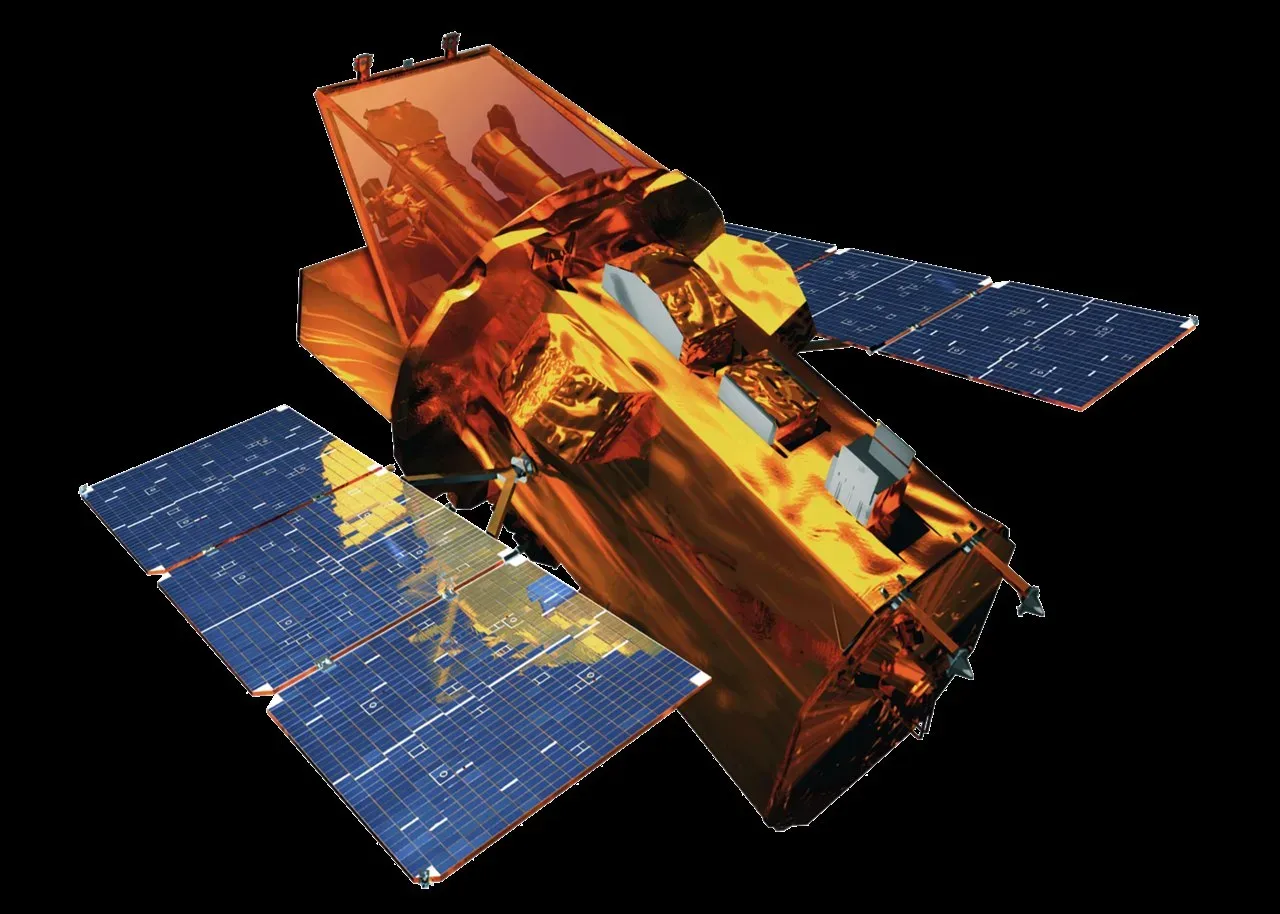
NASA's Swift observatory re-entered Earth's atmosphere over North Sumatra, Indonesia, at 7:39 a.m. EST on 4 November 2026, nearly 22 years after launch. Atmospheric drag, increased by solar activity, pulled it down after a planned boost mission ended in August without trying to lift it.
Table of contents 6 sections
- Swift re-entered over North Sumatra at 7:39 a.m. EST on 4 November 2026, according to the U.S. Space Force.
- NASA expected most of the spacecraft to burn up but said some components may have survived.
- Drag rose with solar activity, and Swift reached 275 kilometers on 20 October before entering safe mode.
- A planned servicing mission ended in August 2026 without attempting a boost.
- Swift launched in 2004 for a two-year prime mission and studied gamma-ray bursts, active galaxies, supernovae and comets.
The Swift observatory reentry took place on Wednesday 4 November 2026, when NASA's Neil Gehrels Swift Observatory fell back into the atmosphere at 7:39 a.m. EST, according to the U.S. Space Force. The spacecraft came down over the North Sumatra region of Indonesia, at about 3.4 degrees north and 98.6 degrees east, almost 22 years after it launched.
NASA said it expected most of the spacecraft to burn up on the way down, while adding that some components may have survived reentry. The agency's reentry post gave no debris risk figure, and no wreckage had been reported in the sources reviewed for this article.
Why did Swift come down?
Swift circled Earth in low orbit, where a thin trace of atmosphere still drags on every satellite. When solar activity rises, that atmosphere swells and the drag grows. NASA's operations team said the observatory began sinking rapidly after a recent increase in solar activity.
The agency had planned a servicing mission to lift the spacecraft to a safer orbit, but that effort ended in August 2026 without attempting a boost. Swift then returned to science work. NASA's mission blog says observations restarted on 28 August and that the telescope looked at hundreds of science targets after that. Pointing the instruments around adds drag, and the observatory began to sink fast a second time.
On 20 October, Swift reached an altitude of 171 miles, or 275 kilometers. At that point it could no longer make up for the added drag and entered safe mode. The operations team at Penn State University sent a command that effectively ended Swift operations so the spacecraft could be prepared for reentry. NASA announced the end of the mission on 23 October and said reentry was expected within a few weeks. It came about two weeks later.
What did Swift do during its time in orbit?
Swift launched on 20 November 2004 as a mission to study gamma-ray bursts, the brief flashes of high-energy light that can come from the collapse of massive stars or the merger of compact objects such as neutron stars. It carried three telescopes that observe different kinds of light, and it was built to turn quickly toward a new burst and send an alert so other observatories could follow up.
That rapid response made it a standard tool for the field. Over the years its work also reached beyond bursts. NASA lists active galaxies powered by supermassive black holes, X-ray flaring stars, supernovae, and comets and asteroids in the solar system among the targets it studied.
The mission was designed for a two-year prime phase. It kept working for close to 22 years, so it operated for roughly 1,000 percent of the life it was designed for, a figure that comes from simple arithmetic on the launch and reentry dates rather than from NASA. The ScienceDaily summary of NASA's post puts the same point in words, saying it ran more than ten times longer than planned.
What does the Swift observatory reentry mean for burst astronomy?
The loss removes a spacecraft that was built to turn quickly toward a transient and report it to the world. Other missions watch for bursts, and ground telescopes follow them up, so the field continues. What changes is the supply of fast, precise X-ray and ultraviolet positions that Swift routinely provided.
NASA's pages do not say how the agency plans to cover that gap, and they do not describe a replacement. Readers who want to know about future capability should look to NASA's astrophysics announcements rather than to this reentry notice. Claims that a specific successor will take over are not supported by the pages NASA has published so far.
Is falling debris a risk?
Most large satellites that come down uncontrolled break apart and burn, and the pieces that survive usually land in the ocean because most of Earth is water. NASA's own wording was cautious: most of the spacecraft was expected to burn up, and some components may have survived. The agency has not said whether any debris reached the ground.
Anyone who finds metal debris that might be spacecraft hardware should not handle it and should report it to local authorities. NASA has not issued a public request for debris reports in the pages reviewed here.
Why Swift's fall matters for other satellites
Swift is a reminder that low-orbit spacecraft depend on a space environment that shifts with the Sun. A period of strong solar activity heats and expands the upper atmosphere, and satellites that cannot raise their own orbit lose height faster than planned. NASA's plan to lift Swift with a servicing mission was meant to answer exactly that problem.
For operators of small satellites and observatories this is a planning problem more than a surprise, since drag is predictable in general and hard to forecast in detail. A servicing mission that does not launch on schedule can end a mission years after its designed lifetime.
What to watch next
The first thing to watch is whether NASA publishes a closing summary of Swift's science results, since its end-of-mission page leans on past discoveries rather than on a full tally. The second is whether any debris is recovered or reported from the North Sumatra track. A third is any statement on how burst alerts will be handled with Swift gone.
Sky watchers can follow the rest of the month's astronomy in our November 2026 night sky guide. The original mission posts are on NASA's site, including the reentry update and the earlier announcement that the mission had ended.
Frequently asked
- NASA's Swift Observatory to Re-Enter Atmosphere — NASA Science
- NASA's Swift Mission Ends Ahead of Re-Entry — NASA Science
- NASA's Swift Telescope Falls to Earth After Nearly 22 Years in Space — ScienceDaily

0 comments
No comments yet — be the first.