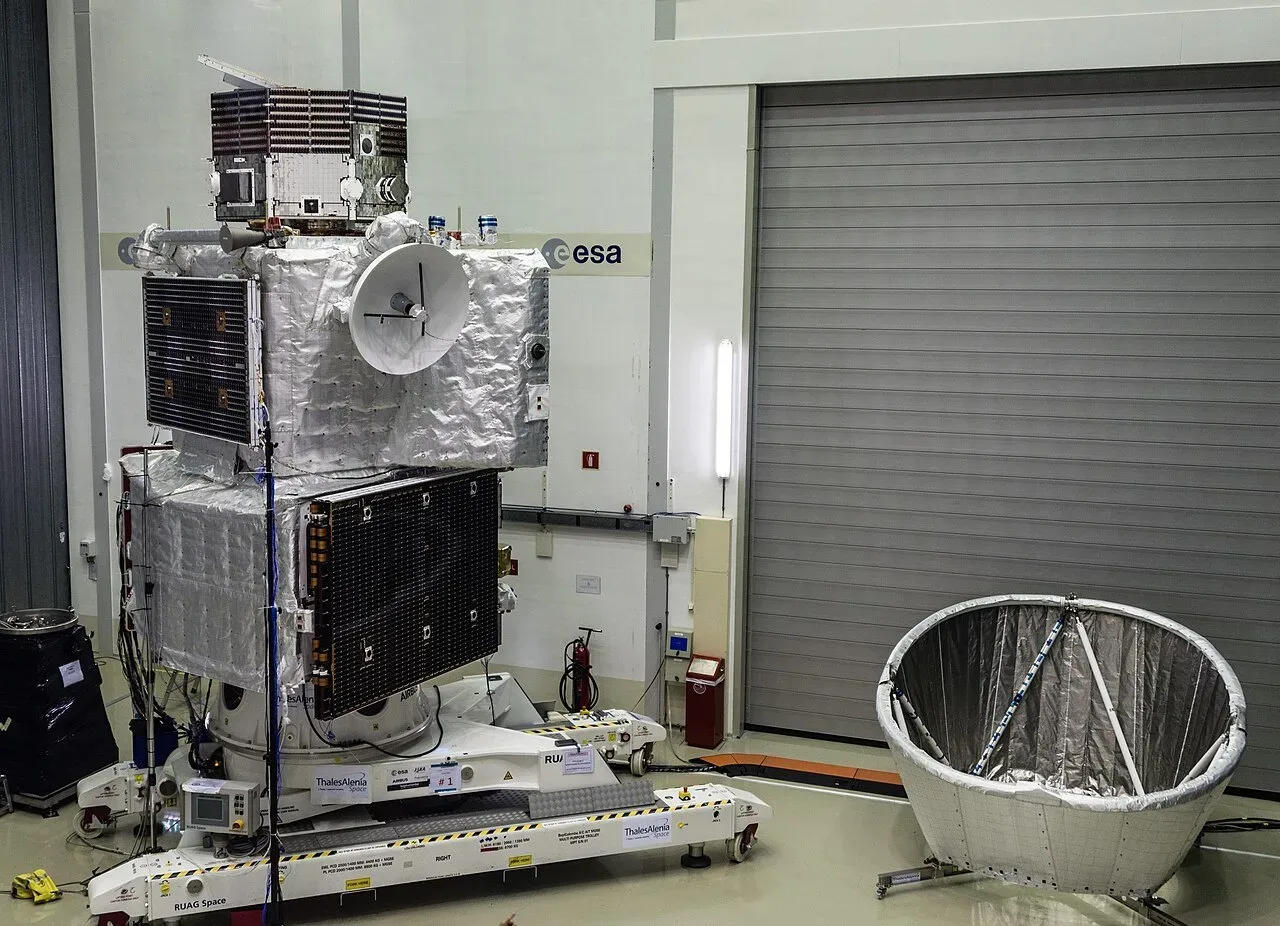
BepiColombo, the joint ESA and JAXA mission launched on 20 October 2018, is scheduled to enter orbit around Mercury on 21 November 2026. Its two orbiters, ESA's MPO and JAXA's Mio, are due to separate on 9 to 10 December 2026, and the science phase is set to begin in April 2027.
Table of contents 6 sections
- BepiColombo is scheduled to enter orbit around Mercury on 21 November 2026, more than eight years after launch.
- The Mercury Transfer Module separated on 3 September 2026, starting the arrival phase.
- A thruster problem found in April 2024 added 11 months and moved arrival from December 2025 to November 2026.
- ESA's MPO and JAXA's Mio separate on 9 to 10 December, and science operations begin in April 2027.
- A 2017 estimate put the mission's cost at about 1.65 billion euros.
After more than eight years in space, the European and Japanese BepiColombo spacecraft is scheduled to enter orbit around Mercury on 21 November 2026. The BepiColombo Mercury orbit insertion is the moment the mission stops being a cruise and becomes the first attempt to study the smallest planet with two orbiters at once.
The arrival phase started on 3 September, when the spacecraft shed the Mercury Transfer Module that had carried it across the inner solar system. Since then, the European Space Agency says, the remaining stack has switched on its instruments and fired its own thrusters for the first time in this configuration.
What happens on 21 November?
On that date the composite spacecraft, ESA's Mercury Planetary Orbiter (MPO) with JAXA's Mercury Magnetospheric Orbiter, known as Mio, still attached, is due to be captured into orbit around the planet. The ESA mission overview describes a polar orbit reached through a technique called weak stability boundary capture, after which the MPO lowers itself to its working orbit once Mio is in place.
Preparation is already under way. On 24 September the MPO fired its thrusters for 8 minutes and 42 seconds, changing its velocity by 11.4 metres per second, the first planned trajectory correction since separation. According to ESA's arrival updates, further small corrections are planned to target the orbit precisely before the main insertion in November.
The BepiColombo Mercury orbit timeline
- 20 October 2018: launch on an Ariane 5 from Kourou, French Guiana.
- 2020 to 2025: one Earth flyby, two Venus flybys and six Mercury flybys to shed speed.
- 3 September 2026: the Mercury Transfer Module separates, confirmed through ESA ground stations in Cebreros, Spain, and Malargüe, Argentina.
- 15 September 2026: all MPO instruments are switched on together for the first time since separation.
- 21 November 2026: scheduled orbit insertion.
- 9 to 10 December 2026: MPO and Mio separate.
- April 2027: the science phase begins.
Why BepiColombo arrives a year late
The mission was originally due to arrive in December 2025. During a manoeuvre on 26 April 2024 the spacecraft's electric thrusters could not run at full power, and ESA reported the problem in May 2024. The revised route added 11 months to the cruise and moved arrival to November 2026.
Getting to Mercury is hard for a counterintuitive reason. The planet sits deep in the Sun's gravity well, so a spacecraft falls toward it and gains speed the whole way. Most of BepiColombo's journey has been about losing speed, through those nine planetary flybys and long stretches of electric propulsion, so that Mercury can capture it.
The mission is not cheap. A 2017 estimate cited in public mission records put its cost at about 1.65 billion euros, which explains the care being taken with each step of arrival.
Is the spacecraft healthy after separation?
The early checks are encouraging. ESA reports that the BELA laser altimeter fired for 21.5 hours and emitted more than 700,000 pulses, the MERTIS infrared instrument completed a 22-hour test returning about 1 gigabit of data with little loss in sensitivity, and the SIMBIO-SYS camera took its first image in space. Telemetry after separation was nominal, and the MPO's solar panels were charging its batteries.
The separation itself ran automatically, with no opportunity for real-time intervention from the ground, a reminder of how much deep space missions depend on pre-programmed sequences. That is a different kind of autonomy from the AI agents now debated on Earth, but the principle of trusting software to act alone is the same.
What will the two orbiters study?
The MPO is the mapper. ESA lists its goals as a complete map of Mercury at different wavelengths, charting the planet's minerals and elements, and testing whether its interior is still partly molten. Mio studies the magnetic field and the environment around the planet, including the extent and origin of Mercury's magnetic field.
After the split in December, the two spacecraft go into different orbits. The MPO is planned to settle into a low science orbit of roughly 480 by 1,500 kilometres that takes about 2.4 hours, while Mio flies a much more stretched orbit reaching out to about 11,640 kilometres to sample the magnetosphere. ESA plans observations for at least one Earth year, with the possibility of an extension.
Having two spacecraft at once is the point. One can measure the planet while the other measures how the solar wind and Mercury's field interact, at the same moment, which a single orbiter cannot do.
What to watch next
The first milestone is confirmation of capture on or around 21 November; ESA livestreamed the September separation and posts regular updates on its arrival page. The second is the clean separation of Mio from the MPO on 9 to 10 December, after which each orbiter must reach its own final orbit. The payoff comes from April 2027, when the science phase begins and the first systematic maps and magnetic field measurements should start to appear.
Frequently asked
- Latest updates: BepiColombo's arrival at Mercury — European Space Agency
- BepiColombo overview — European Space Agency
- BepiColombo Begins Final Approach to Mercury — Sci.News
- BepiColombo — Wikipedia

0 comments
No comments yet — be the first.