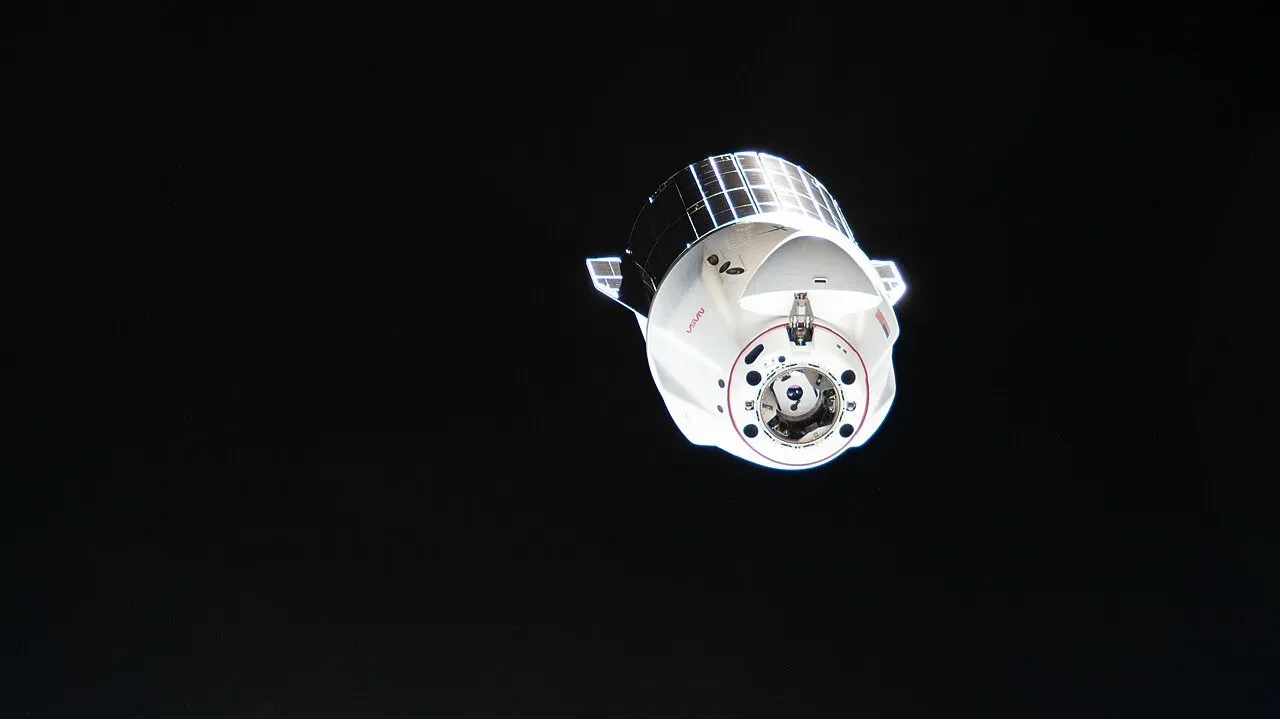
SpaceX's Dragon cargo capsule undocked from the International Space Station at 12:05 p.m. EST on 20 November, ending the CRS-35 resupply mission. It carries research samples including tumor organoids and a bioprinted blood vessel. Splashdown is planned off California at about 4:55 p.m. EST on 21 November.
Table of contents 5 sections
- Dragon undocked from the Harmony module at 12:05 p.m. EST on 20 November after a command from SpaceX ground controllers.
- Splashdown is planned off the California coast at about 4:55 p.m. EST on 21 November, and NASA will not stream it.
- Returning research includes a 3D-bioprinted blood vessel construct, frozen tumor organoids and frozen microbial samples.
- Dragon is the only active cargo craft that can return significant cargo to Earth, since Cygnus, Progress and HTV-X burn up on reentry.
- NASA has not published results from these samples or given a date for them.
A SpaceX Dragon cargo capsule undocked from the International Space Station at 12:05 p.m. EST on 20 November, starting the return leg of the 35th SpaceX resupply mission for NASA. Splashdown is planned for about 4:55 p.m. EST on Saturday, 21 November, in the Pacific Ocean off the California coast.
Dragon is bringing back thousands of pounds of cargo, including research samples from experiments on cancer, vascular aging and antibiotic-resistant bacteria. NASA says it will not stream the splashdown, so the first confirmation will come through the space station blog.
When did the Dragon cargo capsule leave the station?
NASA's blog says the unpiloted Dragon undocked from the space-facing port of the Harmony module at 12:05 p.m. EST, after a command from SpaceX ground controllers. The capsule then fired its thrusters to move away from the station. Space.com reports that the station was flying about 260 miles (418 kilometers) above western China at that moment, and that the departure webcast did not show the undocking itself because of a gap in high-bandwidth video coverage.
The mission is known as CRS-35, the 35th SpaceX flight under NASA's Commercial Resupply Services program. Dragon launched on a Falcon 9 rocket from Space Launch Complex 40 at Cape Canaveral Space Force Station in Florida on about 13 October and reached the station on 15 October. It delivered more than 6,300 pounds (2,860 kilograms) of crew cargo, science equipment and other supplies. The cargo included the final set of International Space Station Roll-Out Solar Arrays, which NASA links to a 20 percent to 30 percent power increase for the older arrays they are mounted on.
What research is coming back on Dragon?
NASA lists four returning items that stand out. Each one was prepared or tested in orbit, and each will now go to laboratories on the ground for analysis.
- A 3D-bioprinted blood vessel construct. Scientists used it to study vascular aging and cardiovascular disease, in space and on Earth.
- Frozen tumor organoids. These were treated aboard the station, and NASA says they may help researchers find better cancer treatments and advance personalized medicine.
- Frozen microbial samples. Scientists will study how antibiotic-resistant bacteria survive, adapt and evolve in space.
- A lighting system. After more than three years on the station, it was tested for its potential to support astronauts' sleep and well-being on long missions.
The four items cover very different questions. The blood vessel work asks how aging and heart disease develop in microgravity compared with life on Earth. The organoids test cancer treatments on tissue grown from tumors. The bacteria samples address how drug-resistant microbes behave in space, and the lighting system asks whether better light can help crews sleep on long missions. Together they show how broad the station's research program is, from medicine to crew health.
NASA describes the samples as research meant to support future exploration and to improve life on Earth. The agency has not published results from these particular experiments yet.
Why does the Dragon cargo capsule matter for station science?
Space.com notes that Dragon is the only cargo craft flying today that can bring a significant amount of cargo back to Earth. Northrop Grumman's Cygnus, Russia's Progress and Japan's HTV-X are all expendable, and they burn up on reentry. Of those four vehicles, Dragon is the one that returns frozen samples and hardware intact.
That matters for biology. Frozen organoids and microbial samples cannot be studied properly from images or telemetry alone. Researchers need the physical material in a laboratory, and until a vehicle brings it home, the experiment is only half finished.
What else is docked at the station?
A NASA image caption lists four spacecraft docked to the station on the day of the undocking: the SpaceX Dragon, the Soyuz MS-29 crew spacecraft, and the Progress 95 and 96 resupply ships. The station is currently operating as Expedition 75, according to the categories on NASA's blog post. The caption does not say which vehicle will take the freed space next, and NASA has not said in these posts when the next cargo mission is due.
Long-duration research on the station feeds into plans for missions beyond low Earth orbit. For a look at how NASA tests crews on the ground for life on another world, see our report on the CHAPEA Mars simulation crew, which covers a 378-day isolation study.
What to watch next
The next confirmed event is the splashdown, planned for about 4:55 p.m. EST (1:55 p.m. PST) on 21 November. NASA says it will post updates on the space station blog rather than stream the reentry. Recovery teams then move the capsule and its research samples toward laboratories.
After that, the useful result is scientific. Watch for NASA or the investigators to report what the vascular, tumor organoid and bacteria samples showed. NASA has not given a date for any of them. NASA's own account is in its blog post on Dragon's departure, and Space.com has a report on the return.

0 comments
No comments yet — be the first.