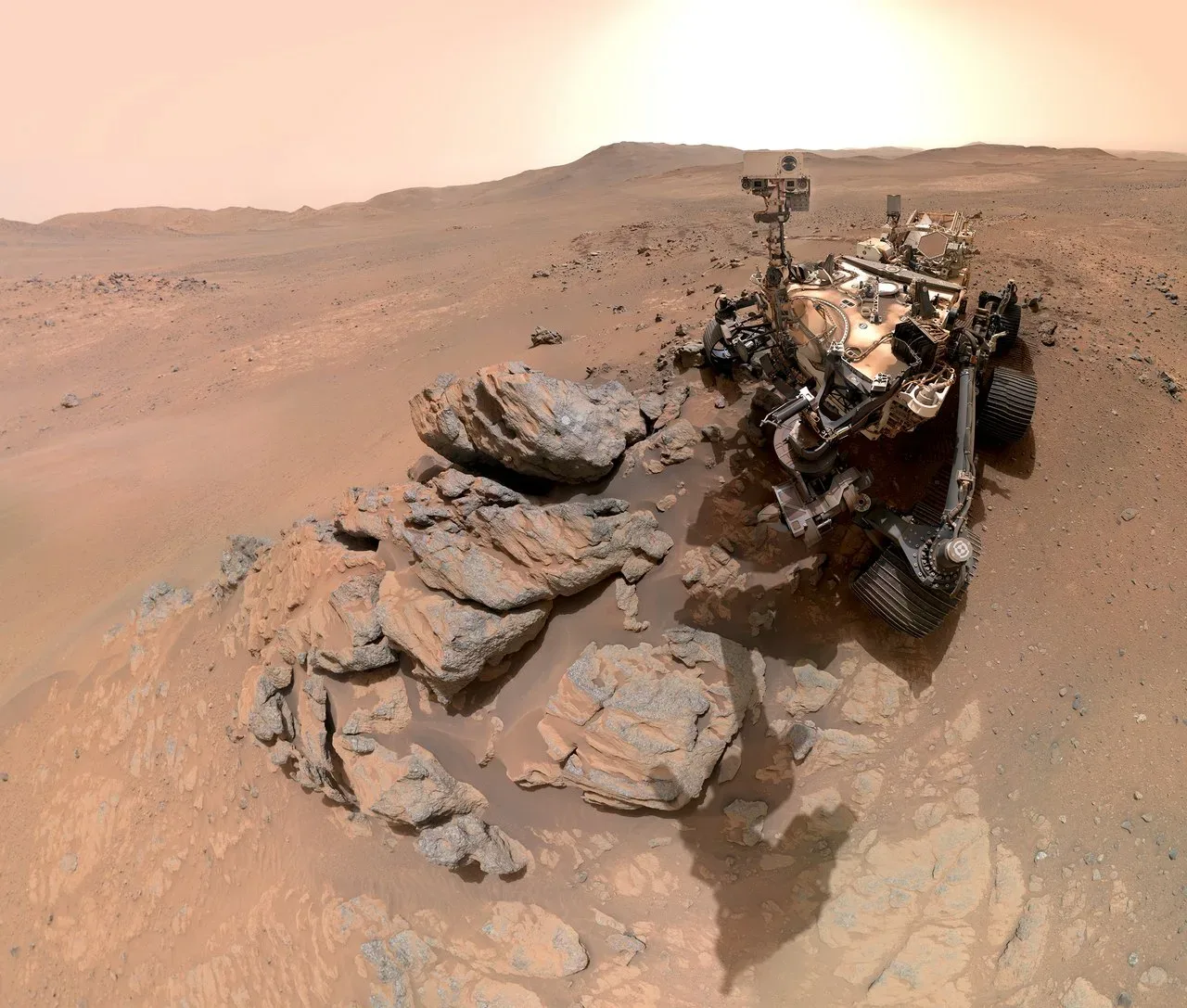
NASA said on 19 November that the Perseverance rover paused science after its primary UHF radio failed on 30 October and its backup transmitted at about half power. The Mars Odyssey orbiter also paused work after a reaction wheel failed. NASA hopes both resume by the end of November.
Table of contents 6 sections
- NASA said on 19 November that Perseverance and Mars Odyssey have both paused science because of separate technical faults.
- Perseverance's primary UHF radio failed on 30 October, and the backup was transmitting at about half its expected power.
- The rover is now using its high-gain antenna to reach the Deep Space Network, so science and raw image capture are paused.
- Odyssey has lost a second of its four reaction wheels, and the remaining hydrazine would support one to two months of thruster-only control.
- NASA hopes both missions return to science by the end of November and will post updates.
NASA announced on 19 November that the Perseverance rover radio problem and a failing reaction wheel on the Mars Odyssey orbiter have paused science at both spacecraft. The agency says the rover is stable and in contact with its team, and it hopes both missions can return to work by the end of November.
The two faults are separate, but they hit the same part of the Mars network at the same time. Odyssey is one of the orbiters that relays data from the surface, and Perseverance's relay radios are the ones that talk to those orbiters.
What went wrong with the Perseverance rover radio?
On 30 October, during startup, the rover's primary UHF downlink radio failed to send its regular heartbeat signals to the main computer, NASA said. The computer registered 25 missed heartbeats, about 100 seconds of silence, before fault protection shut that radio off and switched to the backup. The rover also went into safe mode, which turns off non-essential systems.
A second problem followed. Engineers found the backup radio was transmitting at about half of its expected power, which is roughly 50 percent. NASA says both radios are now out of use until the team learns what caused each fault and decides whether one or both are safe to use again.
How is Perseverance talking to Earth now?
The rover is using its high-gain antenna to talk directly to NASA's Deep Space Network over X-band, according to NASA. That link carries far less data than the relay path through orbiters. The team is saving the bandwidth for diagnostics, so science and instrument operations are paused, and the rover is not capturing or posting raw images during the pause.
Space.com reported that no new raw images from the rover have appeared since 7 November. NASA's Jet Propulsion Laboratory (JPL) has a team assessing the backup radio's performance and the options for restoring it. After that, the team will turn to recovering the primary radio.
Why is the Mars Odyssey reaction wheel a problem?
Odyssey keeps its orientation with four reaction wheels, and it needs at least three of them working. It lost one in 2013. NASA says another wheel has now stopped spinning. The orbiter entered safe mode between 4 and 6 November and is no longer in that state, but its science instruments are still offline.
In one test, the troubled wheel moved when commanded. NASA says more testing is needed to confirm whether it can be recovered. If it cannot, Odyssey would have to steer with its hydrazine thrusters, and the team estimates the remaining propellant would last for one to two months of orientation control. NASA describes those estimates as still being refined.
JPL leads the Odyssey mission, and Lockheed Martin, which built and operates the spacecraft, is working the problem alongside it. The goal is to return to science and relay operations after the tests finish, in the last week of November.
How old are these two missions?
Odyssey launched in April 2001 and reached Mars orbit in October 2001. NASA says it was designed to last just over two and a half years, and it has now operated at Mars longer than any other mission. It produced the first global maps of Martian surface composition and mapped water molecules and buried ice in the top meter of soil. It has also relayed data from Phoenix, Spirit, Opportunity and Curiosity, including their first images after landing.
Perseverance landed in Jezero Crater in February 2021 to assess whether the site could have supported past life and to collect samples for possible return to Earth. Space.com reports that the team determined Jezero hosted a potentially habitable lake billions of years ago, and that the rover found complex organic compounds. Scientists stress that confirming any sign of life would likely require analyzing the samples on Earth. On 11 October the rover passed the off-Earth driving record held by Opportunity, 28.06 miles (45.16 kilometers), roughly 19 days before the radio fault.
What would a longer outage mean for Mars exploration?
NASA has not said that either mission is in danger of ending. It has said that science is paused and that recovery work is under way. The wider point is how much the surface missions lean on orbiters. Relay satellites let a rover send large volumes of data in short passes, and a rover without its relay radios has to send everything through the slower direct link.
That makes the aging relay fleet matter to anything still working on the surface. Odyssey is one of several orbiters in that role. Our report on the ESCAPADE Earth flyby covers another pair of NASA spacecraft headed for Mars.
What to watch next
Three things will show how this ends. The first is whether the Odyssey wheel passes its tests in the last week of November and the orbiter resumes science and relay work. The second is whether JPL can restore the backup radio on Perseverance and bring the rover back to full operations. The third is whether raw images begin appearing again on the mission's public page.
NASA says it will post further updates. The agency's own account is in its 19 November Mars blog post, and Space.com has a report on the two faults.
0 comments
No comments yet — be the first.