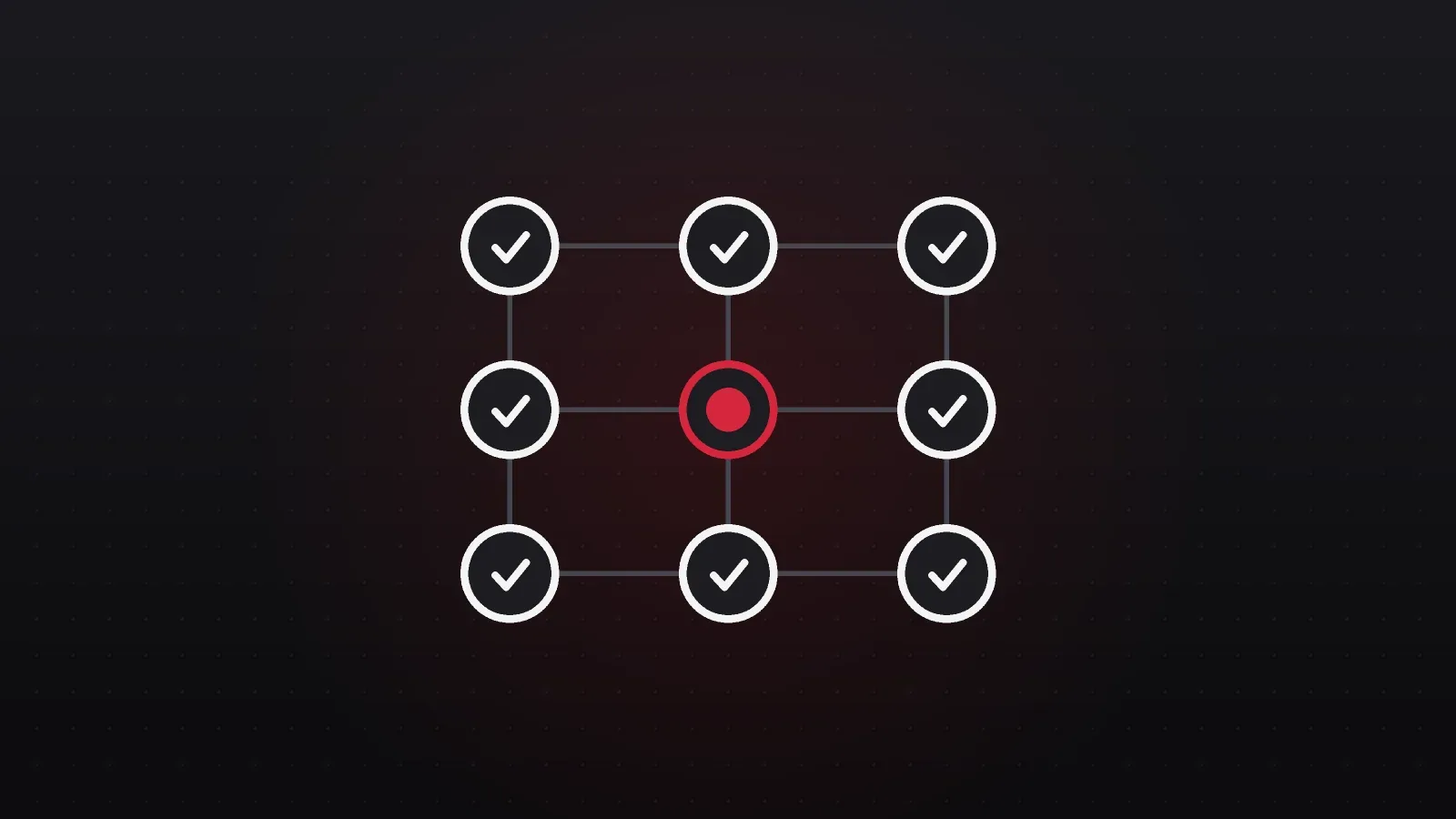
Zero trust security is a model that gives no user, device or network location automatic trust. Every request for access is verified using identity, device health and context, and only the access needed is granted. It replaces the idea that everything inside the network is safe.
Table of contents 6 sections
- Zero trust security removes automatic trust based on network location and checks every access request.
- NIST SP 800-207 defines seven tenets and splits decisions into a policy engine, policy administrator and enforcement point.
- CISA's Zero Trust Maturity Model organises the work into five pillars: identity, devices, networks, applications and workloads, and data.
- Zero trust is a strategy that takes years, not a product, and it does not automatically mean removing your VPN.
- Start with identity and multifactor authentication, then add device checks, least privilege and one pilot use case.
Zero trust security is an approach that treats no user, device or network location as trustworthy by default. Instead of letting anyone inside the company network roam freely, it checks every request for access to every resource, using identity, device health and context, and grants only the access that request needs.
The name is slightly misleading. Trust is not abolished; it is earned request by request, from several signals at once.
How is zero trust security different from the perimeter model?
The older design is often called castle and moat. A firewall guards the network edge, and once you are across it you can usually reach most things inside. NIST's publication SP 800-207, Zero Trust Architecture, published in August 2020, explains why that no longer holds: once attackers breach the perimeter, lateral movement is unhindered, and an organisation with cloud services and remote staff has no single perimeter to defend anyway.
NIST uses an airport to show the weakness: everyone clears one checkpoint, then the whole terminal is trusted. The UK's National Cyber Security Centre (NCSC) uses the same setting for the alternative, where you prove who you are again at each stage and are admitted only to the aircraft you are cleared for. Zero trust assumes an attacker may already be on the network and that your own network is no more trustworthy than anyone else's.
NIST credits the term to John Kindervag, then at Forrester, and notes that it grew out of earlier de-perimeterisation work, such as the Jericho Forum's in 2004.
What are the core principles of zero trust security?
SP 800-207 sets out seven tenets. In plain terms:
- Everything is a resource. Data sources, services and the devices that reach them all need protection.
- Location earns no trust. Communication is secured whether it starts inside the office or outside.
- Access is per session and least privilege. Getting into one resource does not open another.
- Policy is dynamic. Decisions weigh the user's identity, the state of the device and context such as time or behaviour.
- No asset is inherently trusted. The organisation monitors the security posture of everything it owns.
- Verification repeats. Authentication and authorisation are strictly enforced before access and re-evaluated during use.
- Data improves policy. Information on assets, traffic and requests is collected to refine the rules.
How does a zero trust access decision work?
NIST splits the decision into three logical parts: a policy engine, a policy administrator and a policy enforcement point. In practice a request moves through them like this.
- A user or service asks for a resource, such as a file store or an internal application.
- A policy enforcement point in front of the resource, either a gateway or a software agent on the device, intercepts the request.
- The policy engine weighs enterprise policy and live signals, such as device health, threat intelligence and activity logs, and decides to grant, deny or revoke access.
- The policy administrator carries out that decision by telling the enforcement point to open or close the connection and by issuing any session credential.
- The check does not end at login. If conditions change, the session can be cut off.
What are the pillars of a zero trust program?
CISA's Zero Trust Maturity Model, version 2.0 from April 2023, organises the work into five pillars: identity, devices, networks, applications and workloads, and data. Three capabilities cut across them: visibility and analytics, automation and orchestration, and governance. Each pillar is described at four stages, from traditional through initial and advanced to optimal, and the model is aligned with the US federal strategy in OMB memorandum M-22-09 of January 2022. The maturity model is free to read, and its structure works as a checklist for private organisations too.
Identity underpins the other pillars, because every access decision starts with knowing who or what is asking. Multifactor authentication is its cheapest control: a Microsoft study of enterprise accounts found that it reduced the risk of compromise by 99.22%. Our guides to two-factor authentication and passkeys cover the options.
Is zero trust a product, and does it replace your VPN?
It is not a product. NIST calls it a set of guiding principles rather than a single architecture, and says the transition cannot be achieved by wholesale replacement of technology. The NCSC warns that some vendors suggest their products are zero trust, and describes it as a strategic commitment that may take several years of rearchitecting.
Nor does it automatically mean scrapping your VPN. The NCSC says that finding a replacement for the VPN should not be the goal, and that the two are not mutually exclusive. It adds that existing controls should stay in place until zero trust equivalents are mature, and that traffic arriving through a VPN should not be trusted by default.
How do you start with zero trust security?
- Define the threats you are trying to stop and whether zero trust is warranted, or whether targeted controls would do. The NCSC recommends starting there.
- List your users, devices, services and data. You cannot write policy for what you cannot see.
- Tighten identity first: multifactor authentication on every account that supports it, and phishing-resistant methods for administrators and email.
- Check device health before granting access, so an unpatched or unmanaged laptop gets less than a healthy one.
- Shrink what each account can reach, with least privilege and separate administrator accounts.
- Pilot one use case, such as remote access to a single application, then expand. NIST advises introducing the principles incrementally.
The payoff is practical. CISA's #StopRansomware Guide, which our ransomware explainer summarises, recommends a zero trust architecture with access control as granular as possible to prevent unauthorised access to data and services. A household or small team can apply the same ideas at smaller scale: unique passwords, a second sign-in step, prompt updates and no assumption that every device on your Wi-Fi is safe.
Frequently asked
- NIST SP 800-207: Zero Trust Architecture — NIST
- Zero Trust Maturity Model, Version 2.0 — CISA
- Demystifying Zero Trust — UK National Cyber Security Centre
- How effective is multifactor authentication at deterring cyberattacks? — arXiv



0 comments
No comments yet — be the first.