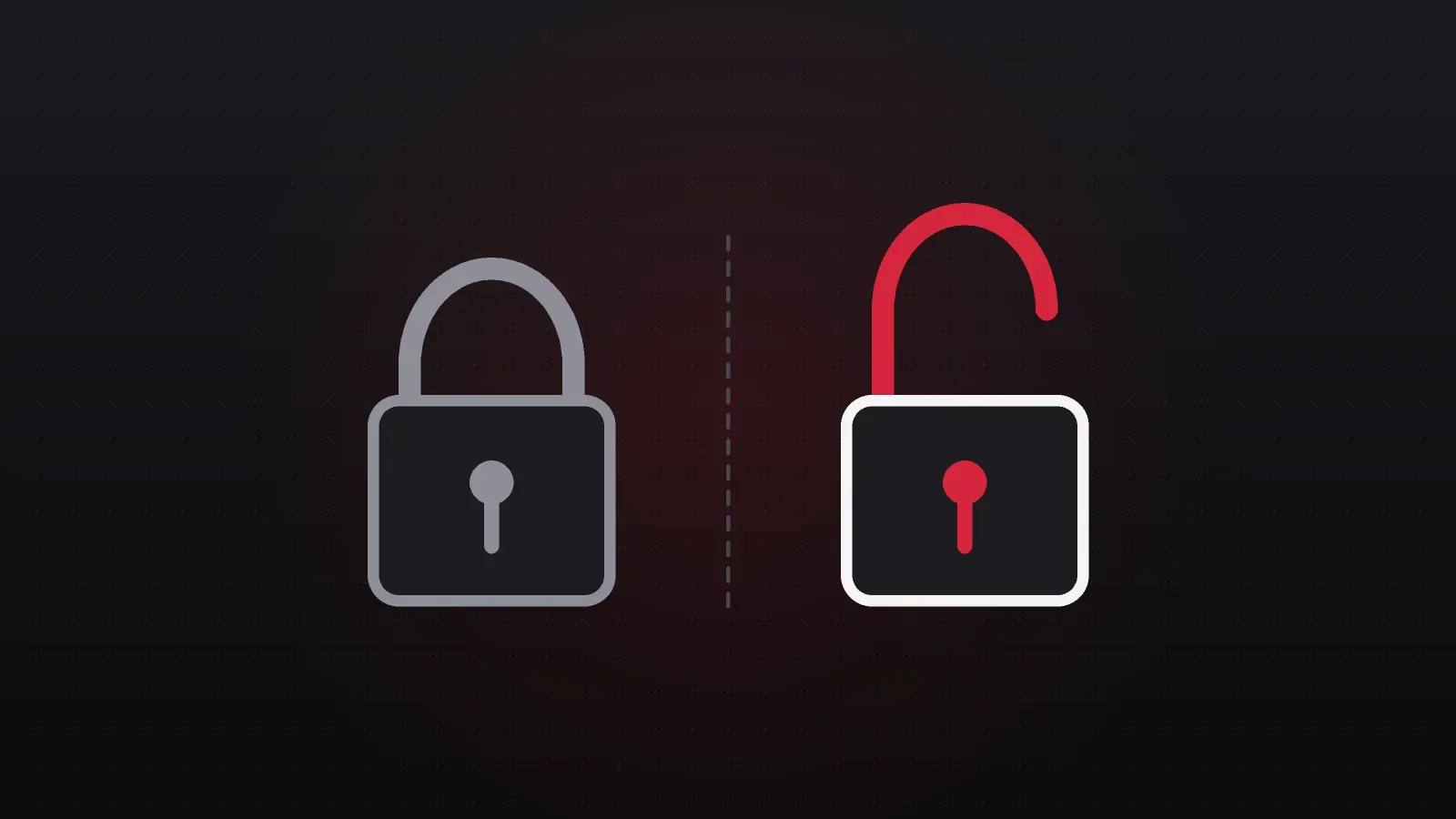
Closed models run only on the vendor's servers, with weights kept private. Open-weight models publish their weights so you can run and adapt them on your own hardware. Open source AI also shares code and training-data details under licences that allow use, study, change and sharing.
Table of contents 6 sections
- Closed models are used only through the vendor's service, while open-weight models publish their parameters for download.
- Open source AI, as the Open Source Initiative defines it, also requires training and running code and detailed information about the training data.
- Some widely used open-weight models fail the open source test because their licences restrict commercial use or certain uses.
- Open models offer control, privacy and customisation; closed models offer easy access, scaling and support but create vendor dependence.
- Choose by data sensitivity, usage volume, in-house skills, customisation needs and licence terms, and test on your own tasks.
Open source vs closed source AI comes down to access. With an open model you can download the files, run them on your own hardware and adapt them; with a closed model you reach it only through the vendor's app or interface, and the vendor controls everything behind it. Between the two sits a large middle group of open-weight models, and because the labels are used loosely, the licence matters more than the marketing.
What do open source, open weights and closed actually mean?
The terms overlap in everyday use. It helps to separate three things.
- Closed (proprietary) models. The weights and training details stay private. You use the model through the vendor's app or an API, and the vendor runs it on its own servers.
- Open-weight models. The trained parameters are published for download, so you can run and fine-tune the model yourself. The training data and training code may not be released, and the licence may limit what you can do.
- Open source AI. The Open Source Initiative's Open Source AI Definition 1.0 requires the freedoms to use, study, modify and share a system. It also requires access to the preferred form for making changes: the parameters, the complete code used to train and run the system, and detailed information about the training data. The data itself need not be released.
In short, every open source AI system publishes its weights, but some open-weight models fall short of the open source definition. The distinction matters because the legal freedoms differ.
Why do some open-weight models fail the open source test?
Often because of the licence. In 2023 the Open Source Initiative said that Meta's Llama 2 licence was not open source, because it restricts commercial use for some users and its acceptable use policy limits how the model can be used. The licence text adds a size line: companies whose products had more than 700 million monthly active users when Llama 2 was released had to request a separate licence from Meta. The Open Source Definition forbids discrimination against persons, groups and fields of endeavour.
Training data is the other sticking point. Under the OSI definition, developers must describe the data in enough detail for a skilled person to build a substantially equivalent system, even when they cannot share it. A release that publishes weights but says little about its data falls short.
Whatever the label, read the licence before you build on a model. Look for limits on commercial use, caps tied to the size of your service, banned uses and attribution requirements.
What do you gain from an open model?
- Control and privacy. You can run the model on your own servers so prompts and documents are not sent to a third party. The US government's 2024 NTIA report lists this confidentiality benefit among the advantages of open weights.
- Customisation. You can fine-tune the weights on your own data, shrink the model for cheaper hardware, or inspect how it behaves.
- Stability. A copy you hold does not change or disappear when a vendor retires a service.
- Cost at scale. You pay for hardware and staff instead of per-use fees, which can be cheaper at steady high volume and dearer at low volume.
- Competition. Open models widen who can take part in AI research and reduce the concentration of market control in a few developers.
What do you gain from a closed model?
A closed model is a service, not a file. You call it through an API, the kind of interface described in our explainer on what an API is, and the vendor handles hardware, scaling and updates. Many vendors also provide safety filtering and support. That makes it the fastest way to start, and you pay for what you use instead of for idle machines.
The price is dependence. The vendor can change a model's behaviour, price or terms, or retire a version, and you cannot inspect the weights or the training data. Your prompts and documents travel to the vendor, governed by its contract.
What are the security and legal trade-offs?
In the open source vs closed source AI debate, safety arguments cut both ways. Published weights cannot be recalled, and anyone can fine-tune a model in ways its developer did not intend. A closed vendor can monitor usage and cut off abusers, but outsiders cannot audit its models. The US National Telecommunications and Information Administration (NTIA) weighed these points in its July 2024 report on open model weights and recommended monitoring the evidence rather than restricting open weights for now.
Regulation treats open releases differently, but only in part. Under the EU AI Act, providers of open-source general-purpose models are excused from some documentation duties, yet they must still publish a copyright policy and a summary of training content, and the exemption ends for models judged to pose systemic risk. Our guide to the EU AI Act's risk tiers, deadlines and fines explains those categories.
Open source vs closed source AI: how do you choose?
- Where must the data stay? If prompts or documents cannot leave your network by law or contract, favour running an open model yourself, or a closed vendor whose contract meets the requirement.
- How steady is the volume? Occasional or spiky use favours paying per request. High, predictable volume may justify your own hardware.
- Who will run it? Self-hosting needs people to manage hardware or rented capacity, monitoring and updates. Our guide to IaaS, PaaS and SaaS shows how much of that burden each service model removes.
- How much customisation do you need? If a better prompt or a retrieval layer gets you there, a closed API may be enough. If you need to change the model itself, open weights give you the option.
- What does the licence allow? Check commercial use, size caps and banned uses before you build a product on it.
- Can you switch? Test candidates on your own tasks rather than on leaderboards, and keep your application able to swap one model for another.
Nothing forces a single choice. You can use a closed service for some jobs and an open model for others.
Frequently asked
- The Open Source AI Definition 1.0 — Open Source Initiative
- Dual-Use Foundation Models with Widely Available Model Weights Report — National Telecommunications and Information Administration (US Department of Commerce)
- Llama 2 Community License Agreement — Meta
- Article 53: Obligations for providers of general-purpose AI models (EU AI Act) — Future of Life Institute (EU AI Act Explorer)



0 comments
No comments yet — be the first.