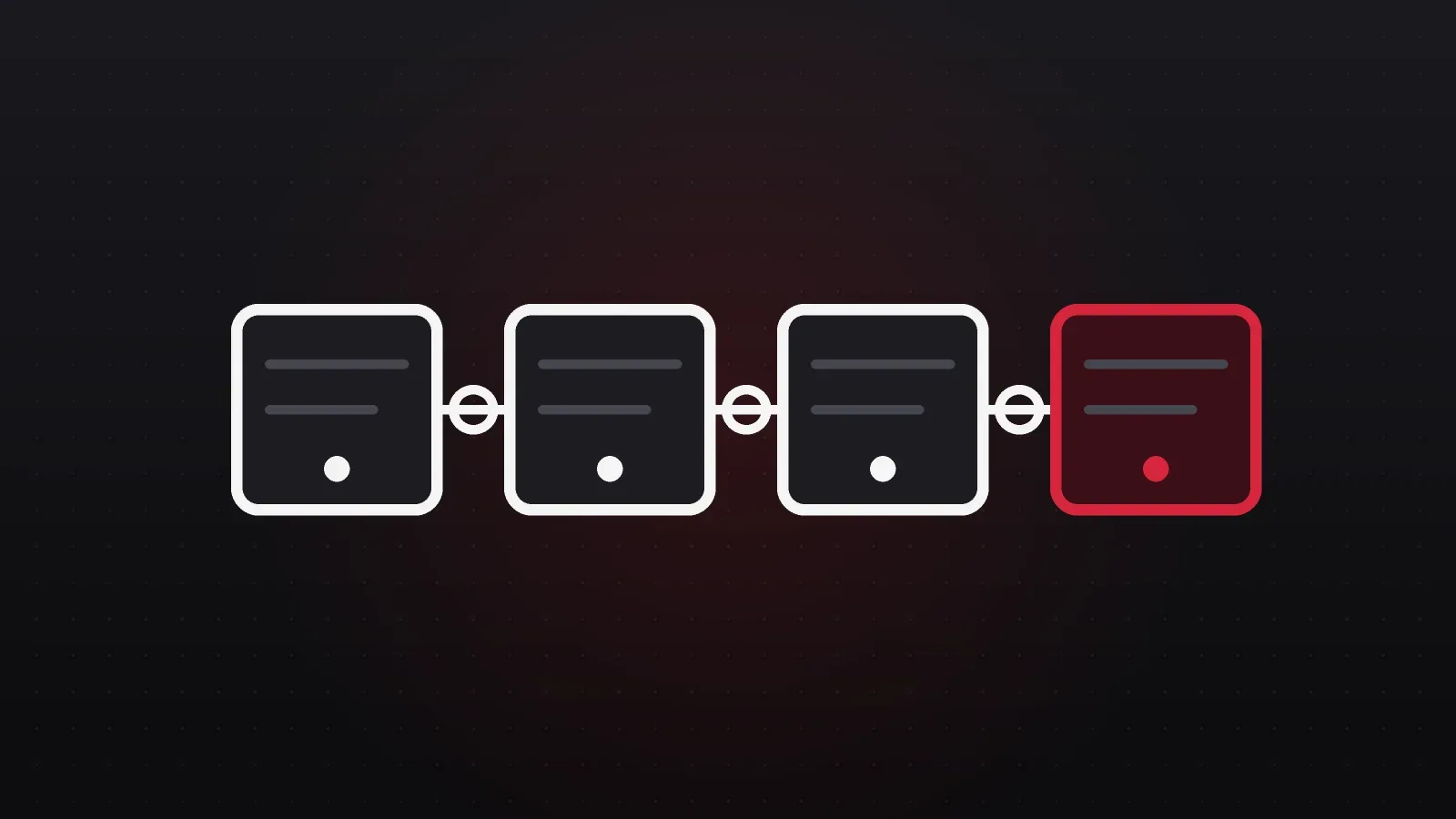
A blockchain is a shared ledger copied across many computers. Transactions are grouped into blocks, and each block stores the hash of the previous one, forming a chain. Altering an old block changes every later hash, so tampering is easy to detect and expensive to carry out.
Table of contents 7 sections
- A blockchain is a distributed ledger kept as identical copies by many computers instead of one central operator.
- Each block stores the hash of the previous block, so altering history breaks every later link.
- Consensus rules such as proof of work and proof of stake decide who adds the next block.
- Blockchains are tamper evident and tamper resistant, not strictly immutable, and public ledgers are not anonymous.
- If one trusted organisation controls the data, an ordinary database is usually the better tool.
Here is how blockchain works in one breath: many computers keep identical copies of a shared ledger, they group new transactions into blocks, and each block carries the cryptographic fingerprint of the block before it. Change an old record and every fingerprint after it stops matching, so the rest of the network can see the tampering.
What is a blockchain in plain terms?
The US National Institute of Standards and Technology (NIST) defines blockchains as tamper evident and tamper resistant digital ledgers kept in a distributed fashion, usually without a central authority such as a bank, company or government. A ledger is simply a list of records. What is unusual is who holds it: every participating computer, called a node, stores its own copy and checks new entries against the rules.
The idea was combined with other technologies in 2008 to create Bitcoin, the first cryptocurrency built on a blockchain. The Bitcoin paper, written under the pseudonym Satoshi Nakamoto, proposed a peer-to-peer network that prevents double-spending without a trusted third party such as a bank. Many blockchains now exist, some public and some private.
How blockchain works, step by step
- You sign a transaction. Your wallet uses your private key to create a digital signature, which proves you control the funds without revealing the key.
- The transaction spreads. Nodes check the signature and the rules, then queue valid transactions to wait for inclusion.
- A block is assembled. A publishing node bundles pending transactions into a block. Its header typically holds the previous block's hash, a hash summarising the transactions, a timestamp and, on mining networks, a number called a nonce.
- The network agrees. The consensus rules, described below, decide whose block is accepted.
- Other nodes verify it. Each re-checks every transaction and rejects a block that contains an invalid one.
- The chain grows. The new block's hash goes into the next block, which links the two together.
Why can't someone just edit an old block?
This is the part of how blockchain works that surprises people most, and the answer is the hash. A cryptographic hash function turns any input into a fixed-length fingerprint called a digest. With SHA-256, widely used in blockchains, the digest is 256 bits long, usually shown as 64 hexadecimal characters. Change a single bit of the input and the output changes completely, and nobody can work backwards from a digest to the input.
Each block stores the hash of its predecessor's header. Altering block 100 changes its hash, which no longer matches the copy stored in block 101. The forger must redo block 101, then 102, and so on, faster than the honest network keeps adding new blocks.
On a large public network that takes control of more than half of the block-producing power, known as a 51 percent attack. NIST notes the attack is not technically difficult, only expensive, and the cost rises the further back the change reaches.
That is why NIST describes blockchains as tamper evident and tamper resistant rather than strictly immutable. The newest blocks can be replaced by a longer competing chain, so most users wait for several more blocks before treating a payment as final.
How do the computers agree on the next block?
Consensus rules decide who may add the next block, and on open networks they make cheating expensive. Two designs dominate.
- Proof of work. Nodes race to find a block header whose hash falls below a target value. Solving the puzzle is hard, but checking an answer is easy. Bitcoin adjusts the difficulty every 2016 blocks to keep the pace near one block every ten minutes, and the computing involved uses a great deal of electricity.
- Proof of stake. Participants lock up cryptocurrency as a stake, and the chance of being chosen to publish a block follows the size of that stake. Ethereum uses this model, in which validators who act dishonestly can lose part of their stake.
Networks also differ in who may take part. Permissionless networks such as Bitcoin let anyone publish blocks. Permissioned networks admit only authorised participants, which suits groups of companies sharing a ledger and often removes the need for costly puzzles.
What can a blockchain do beyond moving coins?
Some blockchains run smart contracts: programs stored on the chain and executed by the nodes, which must all reach the same result. A contract can hold funds and release them when its conditions are met, with no company in the middle. Ethereum is the best-known example.
Because every node must get the same answer, a contract cannot fetch data from the outside world by itself, so it relies on trusted data feeds called oracles. The same shared-ledger design is also used to track goods between companies or to timestamp records, although it only makes sense when several parties need a record that none of them controls.
What are the limits and the common myths?
- Public does not mean anonymous. Bitcoin's ledger shows addresses and amounts openly. If an address is ever linked to a person, its whole history can be traced.
- Lost keys mean lost funds. NIST notes that if a private key is lost, the assets tied to it are lost, because the key cannot be regenerated. The idea of signing with a private key is the same one behind passkeys, which also keep a secret on your device.
- Theft usually targets people. Reports of stolen cryptocurrency almost always mean someone obtained private keys, not that the chain was broken. Fake support messages try to talk victims into revealing recovery phrases, so spotting phishing matters as much as any wallet feature.
- Quantum computers are a future risk. NIST notes that the signature key pairs used on blockchains would need replacing if a powerful quantum computer became real, while hash functions are much less affected. Our explainer on quantum computing covers what such a machine is.
Do you actually need a blockchain?
Test the idea against three conditions.
- Several parties need to write to the same record.
- They lack a single operator that all of them trust.
- They need a tamper-evident history without a central administrator.
If most of these do not apply, a normal database is usually simpler, faster and easier to correct, because one organisation can edit and audit it. Knowing how blockchain works also tells you when you do not need one.
If you only hold cryptocurrency, the practical rules are short. Keep the private key or recovery phrase offline, never type it into a website, and remember that no genuine service will ask for it. Transactions are generally irreversible, so check every address before you send.
Frequently asked
- NIST Internal Report 8202: Blockchain Technology Overview — National Institute of Standards and Technology
- Bitcoin: A Peer-to-Peer Electronic Cash System — Satoshi Nakamoto, bitcoin.org
- Proof-of-stake (PoS) — ethereum.org

0 comments
No comments yet — be the first.