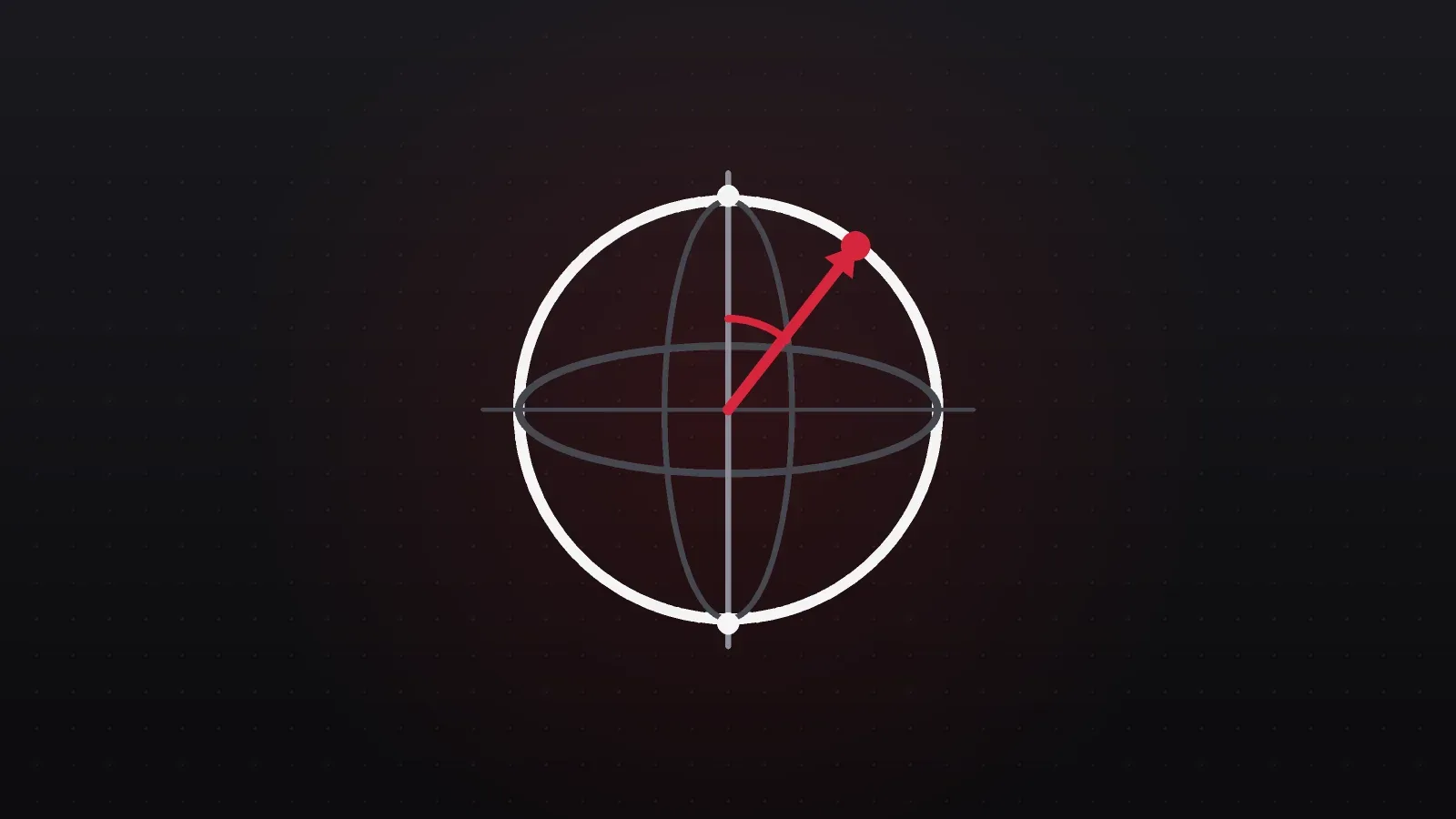
Quantum computing uses qubits, which can hold a weighted mix of 0 and 1, and algorithms that use interference to boost correct answers. It speeds up only some problems, such as simulating molecules or factoring large numbers, while today's machines remain small, noisy and prone to errors.
Table of contents 7 sections
- A qubit holds a weighted mix of 0 and 1 until it is measured, and then returns a single 0 or 1.
- Quantum algorithms work by interference, making wrong answers cancel and right ones reinforce, not by trying every answer at once.
- Errors are the main obstacle, so useful machines need error correction that spreads one logical qubit across many physical ones.
- Craig Gidney's 2025 estimate for breaking 2048-bit RSA is under a million noisy qubits, far beyond today's machines.
- NIST finalized its first three post-quantum standards in August 2024, and organisations should start migrating now.
What is quantum computing? It is a way of calculating with qubits, units of information that can hold a weighted mix of 0 and 1, and with interference that strengthens correct answers while cancelling wrong ones. It does not make every program faster. It offers large speedups only on a narrow set of problems, such as simulating molecules and breaking some forms of encryption.
How is a qubit different from a bit?
A classical bit is always either 0 or 1. A qubit is described by two numbers, called amplitudes, that set the odds of getting 0 or 1 when you finally measure it. Until then it can sit in a weighted mix of both, which physicists call superposition.
The power comes from scale. Two qubits span four combinations, three span eight, and the count doubles with every qubit added, so with 100 qubits the range of possibilities becomes astronomical. That does not mean a quantum computer tries every answer at once and hands you the best one. Measuring collapses the mix to a single result, so the useful trick is to shape the amplitudes beforehand.
What do superposition, entanglement and interference do?
Each plays a separate part, and a short list keeps them apart.
- Superposition lets a register of qubits represent many combinations in a single quantum state.
- Entanglement links qubits so that their results are correlated, and measuring one tells you something about the others.
- Interference does the real work. Amplitudes can add up or cancel, so a well-designed algorithm makes wrong answers cancel and right ones reinforce before you measure.
Designing circuits that achieve this for a useful problem is hard, which is why relatively few algorithms are known to beat classical methods by a wide margin.
What are quantum computers built from?
Several physical designs compete. IBM's overview lists superconducting circuits, trapped ions, quantum dots and photons, and neutral atoms held by laser beams are another approach. Superconducting machines must be cooled to a small fraction of a degree above absolute zero, colder than outer space, so stray energy does not disturb the qubits. Trapped-ion qubits keep their state for longer and can be measured with high fidelity, but they run more slowly.
Programs for these machines are written as circuits: a sequence of gates, which are controlled operations on one or two qubits, followed by a measurement. Developers describe circuits in ordinary programming languages and test them on classical simulators before running them on hardware.
Why are errors the central problem?
Qubits are fragile. Heat, vibration and stray electromagnetic fields make them lose their quantum state, a process called decoherence, and every operation adds a little noise. The physicist John Preskill named the current era NISQ, for noisy intermediate-scale quantum, and pointed out that noise limits the size of circuits that can run reliably.
The fix is error correction, which spreads one reliable "logical" qubit across many physical ones. In IBM's words, that means encoding information into more qubits than you would otherwise need. The overhead is why headline qubit counts mislead: a machine with thousands of noisy qubits may still be unable to run a long calculation, while a smaller machine with lower error rates can do more.
What is quantum computing good for, and what is it not?
The clearest targets are simulating quantum systems, such as molecules and materials, and a few mathematical problems like factoring large numbers. The physicist Richard Feynman argued in the early 1980s that because nature is quantum, the natural way to simulate it is with a quantum machine. Searching unstructured data gets a smaller, quadratic speedup from Grover's algorithm. For everyday work such as browsing, spreadsheets or video, classical processors stay better, and IBM says classical computers will remain the best option for most tasks.
Quantum hardware is not a drop-in accelerator for artificial intelligence either. The models described in our guide to how large language models work train and run on classical chips, and nobody has shown a quantum shortcut that replaces them.
Will quantum computers break encryption?
In the mid-1990s Peter Shor showed that a large, error-corrected quantum computer could factor big numbers and solve discrete logarithms efficiently. Those two problems underpin RSA and elliptic-curve cryptography, the public-key schemes that protect most secure web connections and digital signatures, including those behind passkeys. Symmetric ciphers such as AES are hit far less, because the best known quantum attack gives only a quadratic speedup, which longer keys offset.
How big a machine that would take keeps shrinking on paper. In 2019 Craig Gidney and Martin Ekerå estimated that 2048-bit RSA could be factored in about eight hours using 20 million noisy qubits. In 2025 Gidney lowered the estimate to under a million noisy qubits and less than a week. Both rest on stated assumptions about error rates and hardware, and today's machines are far smaller than either figure.
The risk that matters now is "harvest now, decrypt later": an adversary records encrypted traffic today and decrypts it if a capable machine appears years later. That is why NIST released its first three finalized post-quantum standards in August 2024: FIPS 203 (ML-KEM) for general encryption, and FIPS 204 (ML-DSA) and FIPS 205 (SLH-DSA) for digital signatures. NIST encourages organisations to start adopting them now.
What is quantum computing worth to you today?
For most individuals, not much beyond keeping devices and apps updated, so they pick up new cryptography as vendors ship it. For organisations, the steps are practical:
- List where public-key cryptography is used, including certificates, VPNs, code signing and archives that must stay secret for many years.
- Ask suppliers when they will support the NIST standards.
- Plan for crypto-agility, meaning the ability to swap algorithms without rebuilding systems.
- Protect long-lived data first, since that is what "harvest now, decrypt later" targets.
When you read a claim of "quantum advantage", ask which problem was solved, how the result compares with the best classical method, how many error-corrected qubits were used, and whether others have reproduced it. Answers vaguer than that are marketing.
Frequently asked
- NIST Releases First 3 Finalized Post-Quantum Encryption Standards — NIST
- How to factor 2048 bit RSA integers with less than a million noisy qubits — arXiv (Craig Gidney)
- Quantum Computing in the NISQ era and beyond — arXiv (John Preskill)
- What Is Quantum Computing? — IBM


0 comments
No comments yet — be the first.