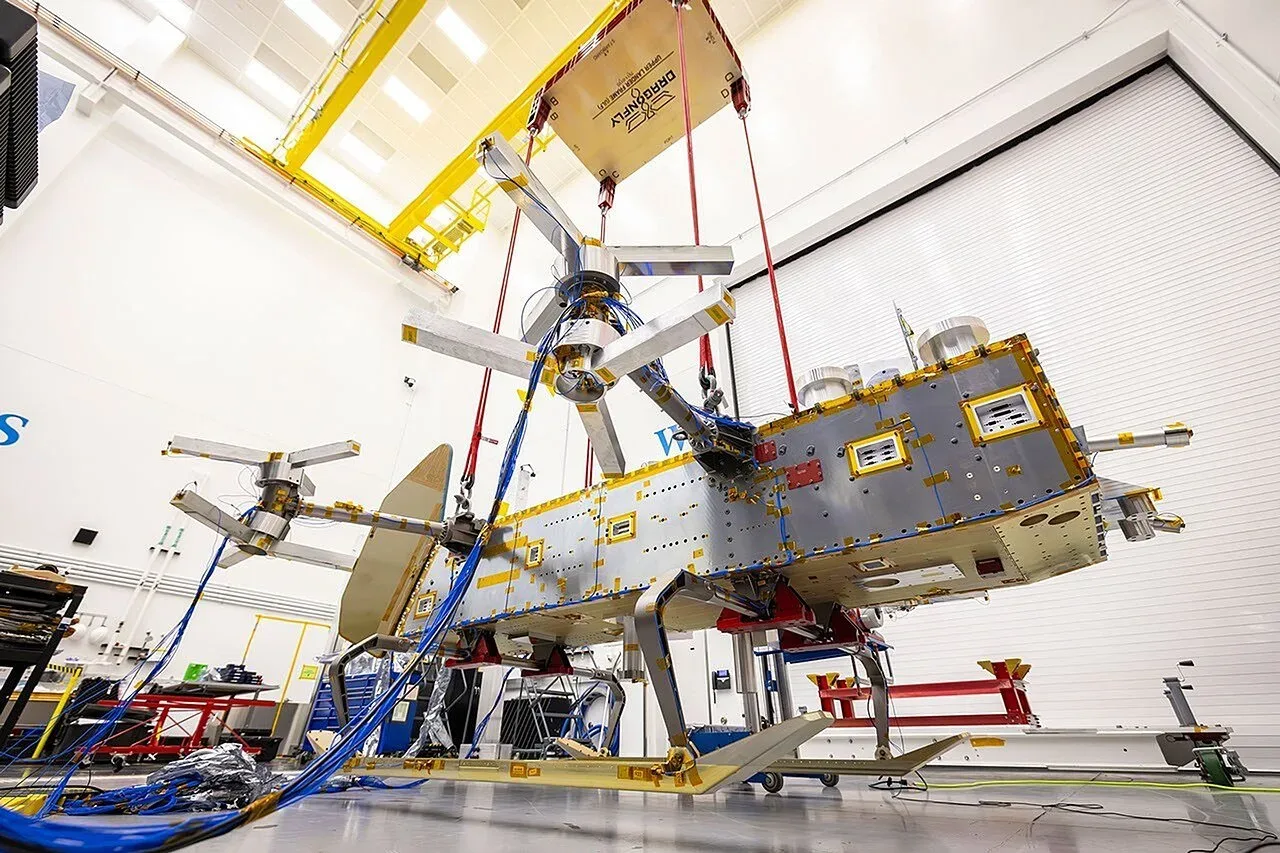
NASA said on 24 November 2026 that all seven DragonCam science cameras are installed on the Dragonfly rotorcraft at Johns Hopkins APL, alongside two navigation cameras. The car-sized vehicle is due to launch in July 2028 and reach Saturn's moon Titan in late 2034.
Table of contents 5 sections
- All seven DragonCam science cameras, built by Malin Space Science Systems, were installed and tested on Dragonfly by mid-November 2026.
- The cameras sit behind windows in a foam enclosure that protects them from Titan's cold, given as minus 290 degrees Fahrenheit.
- Two downward-facing cameras will help judge landing sites before the DrACO sampling tool and a seismometer are deployed.
- An APL-built LED array from infrared to ultraviolet may reveal organic molecules that fluoresce in Titan's roughly eight-day night.
- Launch is set for July 2028 with arrival in late 2034, and four more instrument packages still need delivery and testing.
The Dragonfly rotorcraft cameras are in place. In a post on 24 November 2026, NASA said that by mid-November all seven science cameras of the DragonCam suite had been installed, tested and integrated into the car-sized vehicle, which is being assembled at the Johns Hopkins Applied Physics Laboratory (APL) in Laurel, Maryland, for a flight to Saturn's moon Titan.
Dragonfly is scheduled to launch in July 2028 and reach Titan in late 2034. The cameras are among the first of its instruments to be fully fitted, and NASA says the remaining instrument packages will be delivered, integrated and tested over the next several months.
What the Dragonfly rotorcraft cameras will do
DragonCam was built by Malin Space Science Systems (MSSS). Each of the seven cameras sits in an insulated housing and looks out through a window in a foam enclosure. The enclosure shields the cameras and the rotorcraft's interior from the cryogenic conditions on Titan, where NASA gives the ambient temperature as minus 290 degrees Fahrenheit.
The layout is built around different jobs. Two forward-mounted cameras, a wide-angle camera with a 90-degree field of view and a medium-angle camera, work together to give stereoscopic views of the terrain ahead. Two side-mounted wide-angle cameras are meant to produce panoramas. Two downward-facing wide-angle cameras will help the team judge whether a landing site is safe before the rotorcraft deploys its sample-collection tool, called DrACO, and a seismometer. A high-resolution microscopic imager will examine sand grains only millimeters across at the drill site.
Taken together, the Dragonfly rotorcraft cameras cover three needs at once: seeing the terrain while flying, picking a safe place to land, and studying the ground up close once the vehicle is down. NASA's post describes each group of cameras by its position on the vehicle, which shows how much of the mission's decision making depends on images. The pictures will also give scientists on Earth the context they need to interpret the samples the vehicle collects, a point Carolyn Ernst makes in her comment below.
A light source for a dark world
APL also built a configurable LED array that spans infrared to ultraviolet light. NASA says it can help scientists infer the composition of surface materials. It may also reveal organic molecules that fluoresce under ultraviolet light during Titan's night, which lasts nearly eight Earth days.
Dragonfly also carries two navigation cameras from MSSS, installed over the summer. They are separate from the seven DragonCam imagers, which makes nine cameras in all according to NASA's description.
What the team says the cameras are for
Elizabeth Turtle, the Dragonfly principal investigator at APL, pointed to the new viewpoints the mission will offer. "One of the most exciting things about Dragonfly is that we'll be able to see Titan from perspectives we've never had before," she said.
Michael Ravine, DragonCam development manager and a Dragonfly co-investigator at MSSS, said the cameras are the mission's way of looking at an unfamiliar place. "These will be our eyes to see and explore this whole new world," he said.
Carolyn Ernst, DragonCam instrument scientist at APL, tied the imagers to the sampling work. "DragonCam will give us critical context for the samples collected by DrACO," she said.
Why a flying lander is being sent to Titan
NASA confirmed Dragonfly on 16 April 2024, with a total life-cycle cost of $3.35 billion and a launch readiness date of July 2028, according to an APL release the next day. The lander has eight rotors and flies autonomously, and the plan is for it to fly between dozens of landing sites rather than sit in one place. A heavy-lift launch vehicle was directed to shorten the cruise, which APL described as roughly six years.
Moving by air lets the mission sample different kinds of terrain in a single mission, and the cameras are what let it choose where to touch down. Nicky Fox, associate administrator of NASA's Science Mission Directorate when the mission was confirmed in 2024, said exploring Titan "will push the boundaries of what we can do with rotorcraft outside of Earth."
Readers following the agency's other deep-space projects can compare this schedule with the ESCAPADE flyby of Earth on its way to Mars, which is a much shorter trip.
What is still to be done
The camera milestone does not mean the vehicle is finished. The instrument packages named DraGNS, DraGMet, DraMS and DrACO are still due for delivery, integration and testing. Photos NASA released with the post show the work in the APL cleanroom on 6 and 9 November 2026.
The launch date is the figure to watch. NASA's own post gives July 2028, which matches the readiness date set in 2024, but schedules for planetary missions can move as testing turns up problems. Further updates on the instruments and on system-level testing are likely to appear on NASA's Dragonfly pages over the coming months, and the full 2024 mission description is in the APL release.
Frequently asked
- NASA's Titan-Bound Dragonfly Rotorcraft Gets Its Eyes — NASA Science
- NASA Confirms APL-Led Dragonfly Mission to Saturn Moon Titan — Johns Hopkins Applied Physics Laboratory


0 comments
No comments yet — be the first.