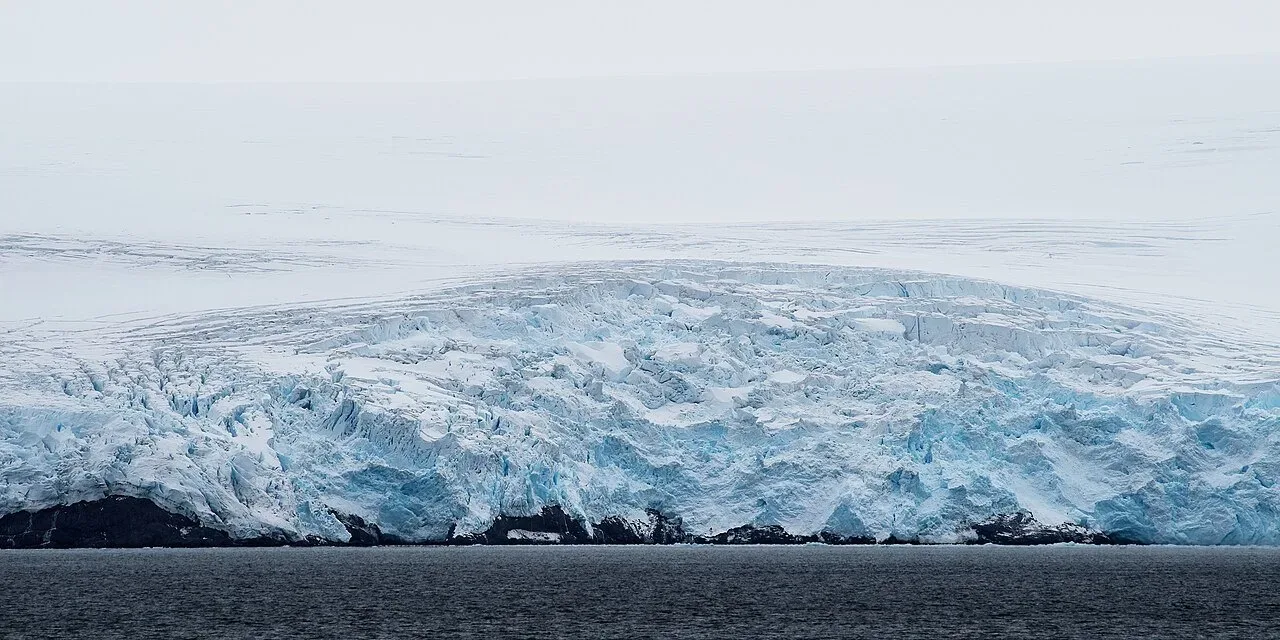
NASA and NOAA reported on 4 November 2026 that the Antarctic ozone hole averaged about 9.6 million square miles from 7 September to 13 October, the seventh largest in 48 years and the largest in about a decade. An unusually strong polar vortex caused it, and recovery is still expected by the 2070s.
Table of contents 6 sections
- The 2026 hole averaged about 9.6 million square miles and peaked at 10.5 million square miles on 18 September.
- It ranks seventh largest in 48 years of records and is the biggest in roughly a decade.
- An unusually strong polar vortex enlarged the hole, according to NASA and NOAA scientists.
- Ozone over the South Pole bottomed out at 105 Dobson units on 17 October, above the record low of 92.
- Scientists still estimate the Antarctic ozone hole will recover by the 2070s.
The Antarctic ozone hole 2026 averaged about 9.6 million square miles between 7 September and 13 October, NASA and NOAA reported on 4 November. That ranks seventh largest in 48 years of satellite and ground records and is the biggest hole in roughly a decade, yet the agencies say the ozone layer remains on track for long-term recovery.
Scientists point to an unusually powerful polar vortex, not a sudden jump in ozone-depleting chemicals, as the reason the hole was larger than in recent years.
How big was the Antarctic ozone hole 2026 at its peak?
The seasonal average of about 9.6 million square miles, or 25 million square kilometers, is more than twice the area of the United States. The largest single-day extent came on 18 September, at 10.5 million square miles, or 27.1 million square kilometers. That is about 90 percent of the largest hole ever measured, which was recorded on 9 September 2000.
Depth is a separate measure. NOAA balloon measurements over the South Pole found ozone fell to a low of 105 Dobson units on 17 October. The lowest value on record there is 92 Dobson units, from October 2006. NASA notes the 2026 hole was not as deep as several record holes, and the ozone hole is defined as the area where ozone falls below 220 Dobson units.
Why did the polar vortex make the hole bigger?
The polar vortex is a band of strong winds that circles Antarctica in winter and traps very cold air. Those conditions allow polar stratospheric clouds to form, and chlorine and bromine compounds released by human activity use the surfaces of those clouds to break down ozone once sunlight returns.
Paul Newman of NASA and the University of Maryland, Baltimore County said an unusually powerful polar vortex extended ozone depletion this season. Amy Butler of NOAA explained that weak planetary-scale weather systems in August and September kept the strongest vortex winds farther from the pole by several degrees of latitude. That enlarged the area in which ozone could be destroyed.
Planetary-scale weather systems normally disturb and weaken the vortex. In 2026 they were weak, so the vortex stayed strong for longer.
Is the ozone layer still recovering?
The agencies say yes. Stephen Montzka of NOAA said chlorine in the Antarctic stratosphere from ozone-depleting chemicals has declined by about a third from its level in the 1980s. NASA credits the controls set by the 1987 Montreal Protocol with driving that long-term recovery.
Newman put the protocol's effect in numbers. If ozone-depleting substances were as common as they were at their peak in 2000, the 2026 hole could have been 1 to 2 million square miles larger. Scientists estimate that the Antarctic ozone hole will recover by the 2070s, because the chemicals involved break down very slowly.
Recovery is slow because the chemicals involved stay in the atmosphere for a long time. That is why the agencies give a date in the 2070s and not a nearer one, and why a single season of strong winds can still produce a large hole while the long-term chlorine trend keeps falling.
One year does not reverse a trend, in either direction. NASA and NOAA describe the larger 2026 hole as the product of unusual weather on top of a layer that is recovering, which is why they do not read it as a sign that the treaty has stopped working.
How do scientists measure the hole?
NOAA launches ozonesondes, which are instruments carried by weather balloons, from the South Pole Baseline Atmospheric Observatory and also uses a Dobson spectrophotometer there. Satellite data come from NASA's Aura, NOAA-20, NOAA-21 and the joint NASA and NOAA Suomi NPP mission.
Using several instruments lets the teams cross-check the area, which the satellites measure, against the depth of the layer, which the balloons measure. That is why the 2026 result can be reported as large in area and moderate in depth at the same time.
What does this mean for climate talks?
The ozone hole and climate change are different problems with some shared history. Both involve gases released by human activity, and the Montreal Protocol is often cited as an example of a treaty that worked. The ozone result arrives as governments prepare for the next round of climate negotiations, which we outline in our COP31 Antalya preview.
The ozone data does not change the climate science. It does give negotiators a recent record of what sustained international controls on a pollutant can achieve over decades.
What to watch next
NASA and NOAA will publish further seasonal summaries as the Southern Hemisphere spring ends and the hole closes for the year. The full reports are available from NASA Science, and the ScienceDaily write-up of the NOAA release is here. The agencies' next annual assessment will show whether 2026 was an outlier driven by weather or the start of a pattern.
Frequently asked
- 2026 Ozone Hole — NASA Science
- NASA Reveals Earth's Ozone Hole Has Grown to a Size Not Seen in a Decade — ScienceDaily (NOAA release)

0 comments
No comments yet — be the first.