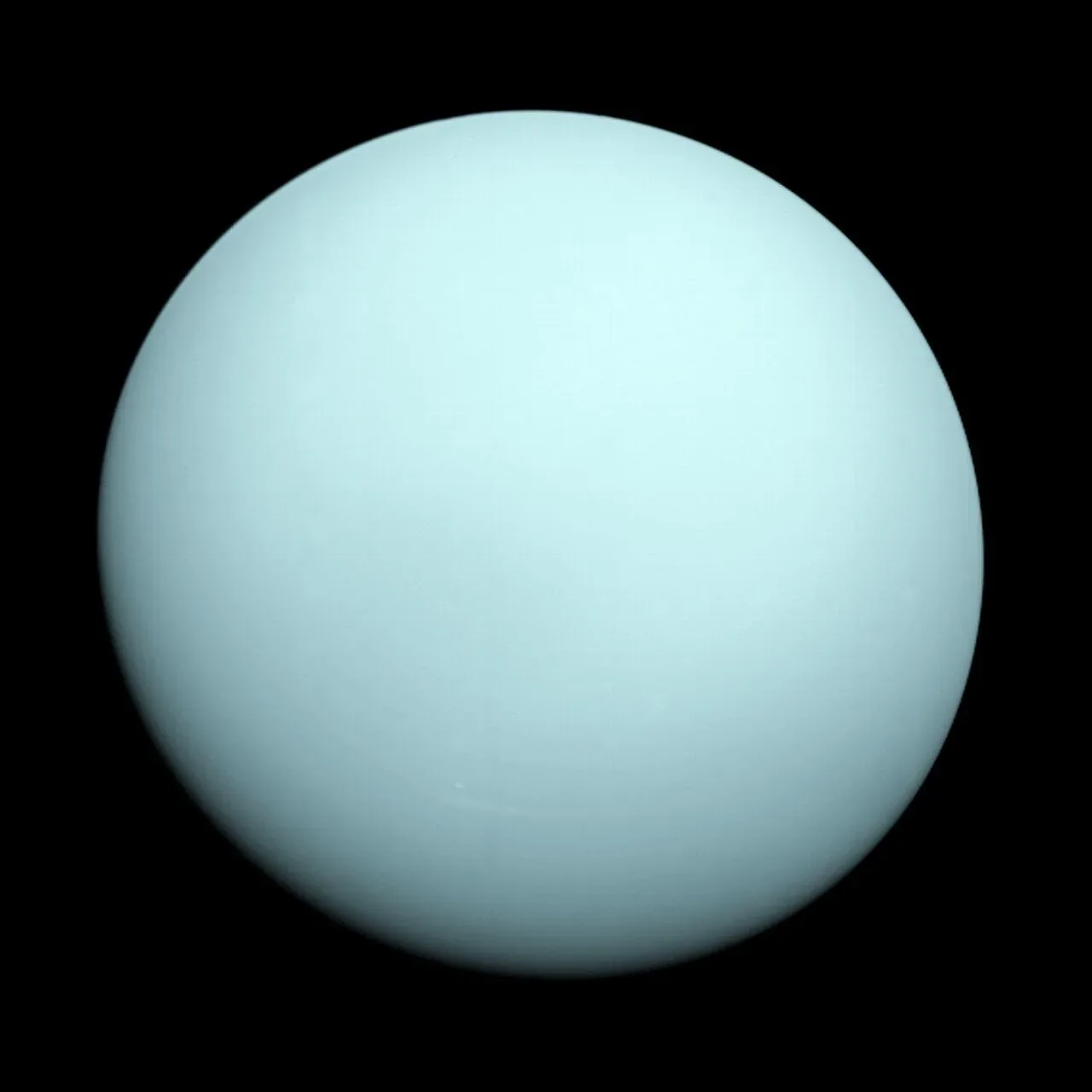
The Uranus magnetic field is tilted 59 degrees and sits off-centre. A study published on 3 November 2026 in Communications Physics used simulations to argue that ionic water makes the deep interior conductive, which reproduces the odd fields of Uranus and Neptune and lets them shift within decades.
Table of contents 5 sections
- Uranus's magnetic field is tilted 59 degrees from its axis, compared with about 11 degrees for Earth.
- Simulations led by Chi Yan reproduce the odd fields of Uranus and Neptune using ionic water deep inside the planets.
- The model suggests Uranus's tilt can swing by tens of degrees within decades.
- The result is not yet confirmed and rests partly on 40-year-old Voyager 2 data.
- JWST aurora observations are planned as a test of the model.
The Uranus magnetic field has puzzled scientists since Voyager 2 flew past the planet in 1986, and a computer-simulation study published on 3 November in Communications Physics offers an explanation. The researchers say the answer lies in how electrically conductive the planets' deep interiors become under extreme pressure.
The work was led by Chi Yan of the University of Texas at Austin, with Tom Stallard of Northumbria University in the UK among the co-authors, according to a Space.com report published on 10 November.
What is odd about the Uranus magnetic field?
Earth's field is close to a tidy bar magnet, with a tilt of about 11 degrees from the planet's rotational axis. Uranus does not fit that pattern. Its field is tilted 59 degrees from its axis and is not centred on the core. Its centre sits about two thirds of the way down towards the core.
Neptune is just as strange. Its field is tilted 47 degrees and is disordered, and its centre lies halfway between the core and the visible cloud tops. Voyager 2 is the only spacecraft to have visited either planet. It passed Uranus in January 1986 and Neptune in August 1989, so every direct field measurement is roughly 40 years old.
How can ionic water explain the Uranus magnetic field?
Earth's field comes from molten iron churning in its outer core, which produces a dipole with clear north and south poles. The ice giants work differently. They hold volatiles such as ammonia, hydrogen, helium, methane and water around a probable rocky core, and their mass creates extreme pressures inside. Uranus is about 14.5 times Earth's mass and Neptune about 17 times.
Under those conditions, water molecules may break apart into ions, and the interior becomes more electrically conductive with depth. According to the Space.com account, the team fed that conductivity and the planets' composition into simulations and reproduced the odd fields of both worlds. In the model, the field structure evolves together with convection-driven fluid motion and the interior temperature.
The idea fits with separate interior modelling. A 2025 preprint by Luca Morf and Ravit Helled, posted on arXiv, built many possible interior structures for both planets. All of them contained convective regions of ionic water, and the authors argued this could explain the non-dipolar magnetic fields. They also suggested that Uranus's field is generated deeper inside than Neptune's.
The preprint also reports a wide spread of possible compositions. Its models range from water-dominated to rock-dominated, with rock-to-water mass ratios from 0.04 to 3.92 for Uranus and from 0.20 to 1.78 for Neptune. The authors say their results challenge the standard "ice giant" label and that better observations are needed to pin down what the planets are made of. In other words, the interior picture is still loose, and a magnetic field that is easier to explain would be one of the few firm constraints.
The magnetic field matters beyond the planets themselves. Uranus and Neptune are the least explored large worlds in the solar system, and a field that behaves very differently from Earth's gives scientists a test case for how planetary dynamos can work when no molten iron is involved. Since Voyager 2 supplied the only close-up readings, any model has to be fitted to a very thin set of measurements.
Distance is part of the problem. According to NASA's Uranus facts page, the planet orbits at an average distance of 2.9 billion kilometers from the Sun.
Could the fields change within decades?
The simulations suggest they can. Yan said Uranus's tilt "swings by tens of degrees within decades" in some periods, while Earth's field drifts only about one degree over 50 years. If that is right, a measurement taken in 1986 may describe one moment in a long, shifting sequence rather than a fixed property of the planet.
That matters for anyone interpreting old data. A single flyby cannot show how a field moves over time, so scientists have had to guess whether Voyager 2 caught a typical state or an unusual one.
What the study has not shown yet
The model is not directly confirmed. Space.com reports that the team plans to compare simulation results with Voyager 2 data and with James Webb Space Telescope observations of infrared aurorae on both planets. Stallard leads the JWST auroral work, and aurorae trace the field, so they offer a way to test whether the model is on the right track.
The idea that a giant collision caused Uranus's tilt does not settle the matter either. That explanation could account for the planet's sideways spin of about 97 degrees, but it does not explain why Neptune has a similarly skewed field. This is why the authors look for a cause that is built into the planets' interiors.
Readers who follow planetary missions may also want the latest on another long-running robotic project, covered in our report on Perseverance's driving record on Mars.
What to watch next
Two things will test the result. The first is the planned comparison with JWST aurora data, which could show whether the infrared glow matches what the model predicts. The second is a return trip. Space.com notes that NASA has prioritised a Uranus mission for the early 2040s, and that China's Tianwen-4, launching towards Jupiter in 2029, will release a small probe that travels on to Uranus using a gravitational slingshot.
Until a spacecraft arrives with a magnetometer, the claim that these fields can move within decades remains a model result. Any follow-up from the Texas and Northumbria teams is the place to look for new measurements.

0 comments
No comments yet — be the first.