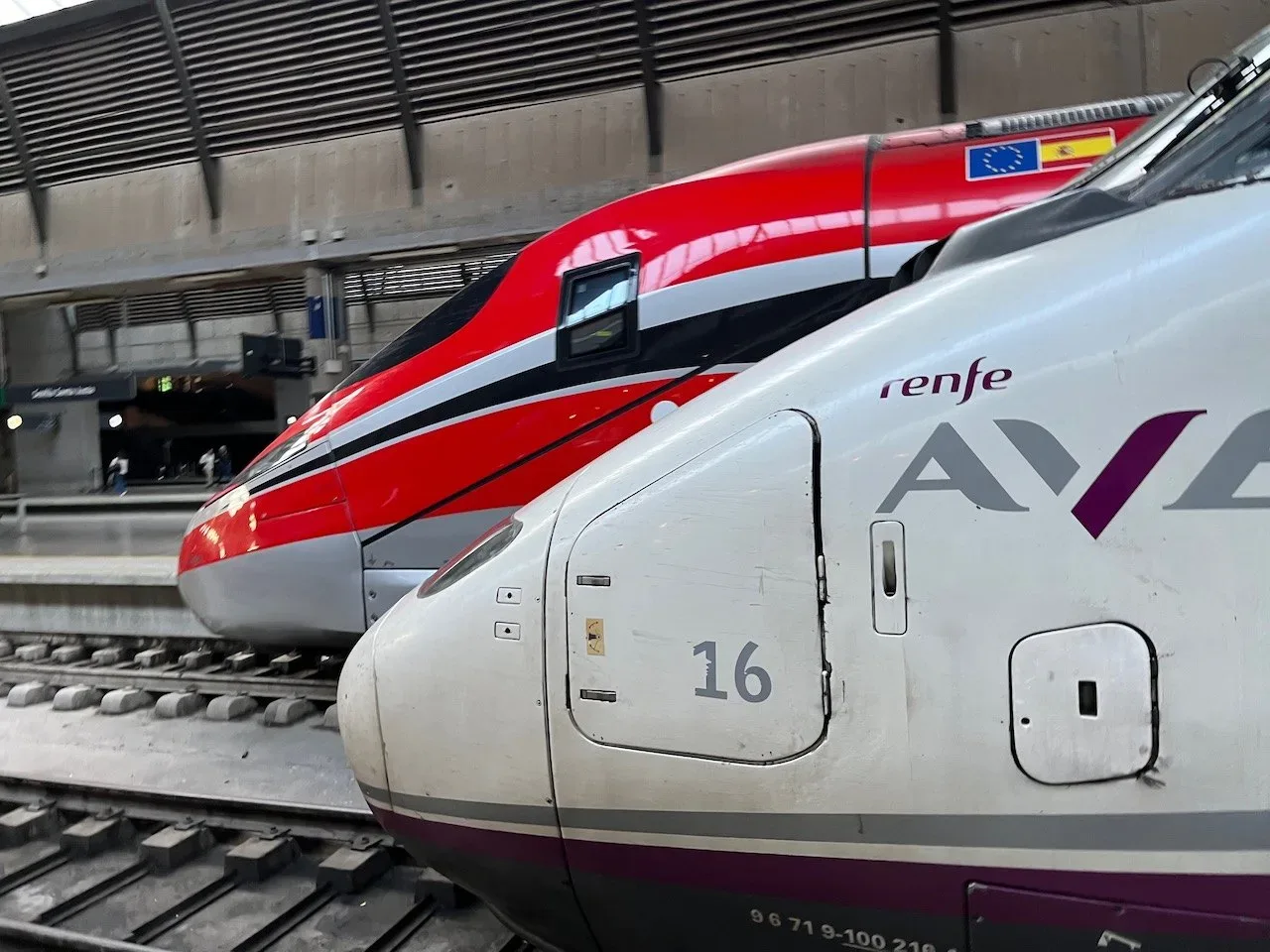
On 28 October 2026 a Renfe high-speed train hit a stalled Iryo train near Urda, Toledo, on the Madrid to Seville line, killing at least 69 people. The line's LZB signalling had failed, and Spain's transport minister blamed an "inexplicable" control-centre order that let the Renfe train move.
Table of contents 6 sections
- A Renfe train hit a stationary Iryo train near Toledo at 8:53 am on 28 October, killing at least 69 people.
- The LZB automatic signalling system had failed about 23 minutes earlier on a 63 km stretch.
- Transport Minister Óscar Puente blamed an "inexplicable" order from the Adif control centre that cleared the Renfe train to move.
- It is Spain's second deadly high-speed crash of 2026, after 46 people died near Adamuz in January.
- High-speed services between Madrid and Andalusia are suspended, and Renfe has halted ticket sales on the corridor until 13 December.
A state-run Renfe high-speed train slammed into the back of a stationary Iryo train near Toledo at 8:53 am on Wednesday 28 October, killing at least 69 people in Spain's deadliest rail disaster since 2013. The Spain train crash happened about 23 minutes after a computer failure knocked out the line's automatic signalling, and the transport minister has blamed an "inexplicable" order from the control centre.
Both trains had left Madrid for Seville that morning. The Iryo service, carrying about 150 people, had stopped on a raised section of track between Urda and Los Yébenes in Castilla-La Mancha. The Renfe train behind it carried close to 400 people. On Time's figures of 393 and 151 aboard, the provisional toll means about 13 percent of everyone on the two trains died. Two Iryo carriages derailed and fell down the embankment.
How the Toledo collision unfolded, minute by minute
The sequence below comes from El País reporting summarised by Al Jazeera and from figures given by Transport Minister Óscar Puente.
- 8:30 am: three computers on the network lost communication and LZB, the line's automatic train control system, went offline on a 63 km stretch. About six trains stopped automatically.
- 8:36 am: controllers at the Adif command centre in Madrid cleared the Renfe train to resume.
- 8:41 am: the same order went to the Iryo train, which could not move.
- 8:48 am: the Iryo driver reported that the train was still stalled.
- 8:53 am: the Renfe train, which had about 25 km to cover, hit the Iryo train.
El País reported that the Renfe train was travelling at more than 200 km/h. Time reported that its speed at impact has not been officially established. Under the rules, trains may run at no more than 40 km/h while LZB is down, because the backup system only detects trains at fixed points.
Who is being blamed for the Spain train crash
Puente has pointed at the control centre rather than the drivers. He said protocols required a red signal to stop the Renfe train from moving and described the decision to let it go as inexplicable.
"Clearly, it was a wrong decision," Puente said, according to Time.
Officials have identified the operator who cleared the Renfe train but had not yet spoken to that person. Renfe says its train moved as instructed. Iryo sources say their driver stopped at a signal and called controllers, as required. Adif, which runs the infrastructure, has not yet identified the point of failure inside its command centre.
An engineer quoted in the reporting said LZB would have prevented the crash had it been working, and El País found there was no trackside signal between the two trains. That is the part of the story that should worry regular passengers: the safety net failed, and the manual fallback depended on a single human decision.
Why the Madrid to Seville line is different
The Madrid to Seville route opened Spain's high-speed era, and it is now the only high-speed line in the country still using LZB, a German system that dates from 1992. Adif awarded a 52-month contract in 2021 to replace it with the EU's standard signalling system, and that work is still under way.
This is Spain's second high-speed disaster this year. On 18 January a Renfe train derailed near Adamuz in Córdoba province and hit an oncoming Iryo train, killing 46 people. The same two operators were involved on the same corridor. Prime Minister Pedro Sánchez said the causes appeared unrelated but called two such crashes in a year "unacceptable for a country like Spain."
Travel disruption and the official response
Sánchez visited the site and declared three days of national mourning from Thursday. Police asked victims' families to give DNA samples to help identify the dead, and the transport ministry's website briefly showed a toll of 74 late on Thursday before reverting to the provisional figure of 69. Castilla-La Mancha's regional president, Emiliano García-Page, said about 80 people were injured, 50 of them seriously.
Adif suspended high-speed services between Madrid and Andalusia. Renfe stopped selling tickets on the corridor until 13 December and began an alternative service on Friday. Madrid to Toledo and Málaga to Seville trains are still running.
If you are thinking of donating to victims' families, give through established organisations and be wary of unsolicited appeals; our guide on how to spot a phishing email covers the common warning signs.
The crash lands in the middle of an election campaign
Spain votes in an early general election on 29 November, called by Sánchez on 5 October after Congress rejected two of his housing decrees. About 1,500 people protested outside the Transport Ministry on Wednesday evening demanding Puente's resignation, and some clashed with police.
Sánchez cancelled campaign rallies. Alberto Núñez Feijóo, leader of the opposition People's Party, which holds a slight poll lead, suspended events during the mourning period and called for a full investigation, saying it was "the moment to respect the dead, the injured and their families." Vox leader Santiago Abascal kept campaigning, called the government "a criminal organisation" and said he would take it to court.
What to watch next
Three things will shape the coming weeks. First, the investigation's account of what failed inside the Adif control centre and why the Renfe train was cleared. Second, whether the government speeds up the replacement of LZB on the Madrid to Seville line. Third, how the disaster affects a campaign in which rail safety is now a central issue. Passengers booked on the Andalusia corridor before mid-December should check Renfe and Iryo for refunds and the alternative service.
0 comments
No comments yet — be the first.