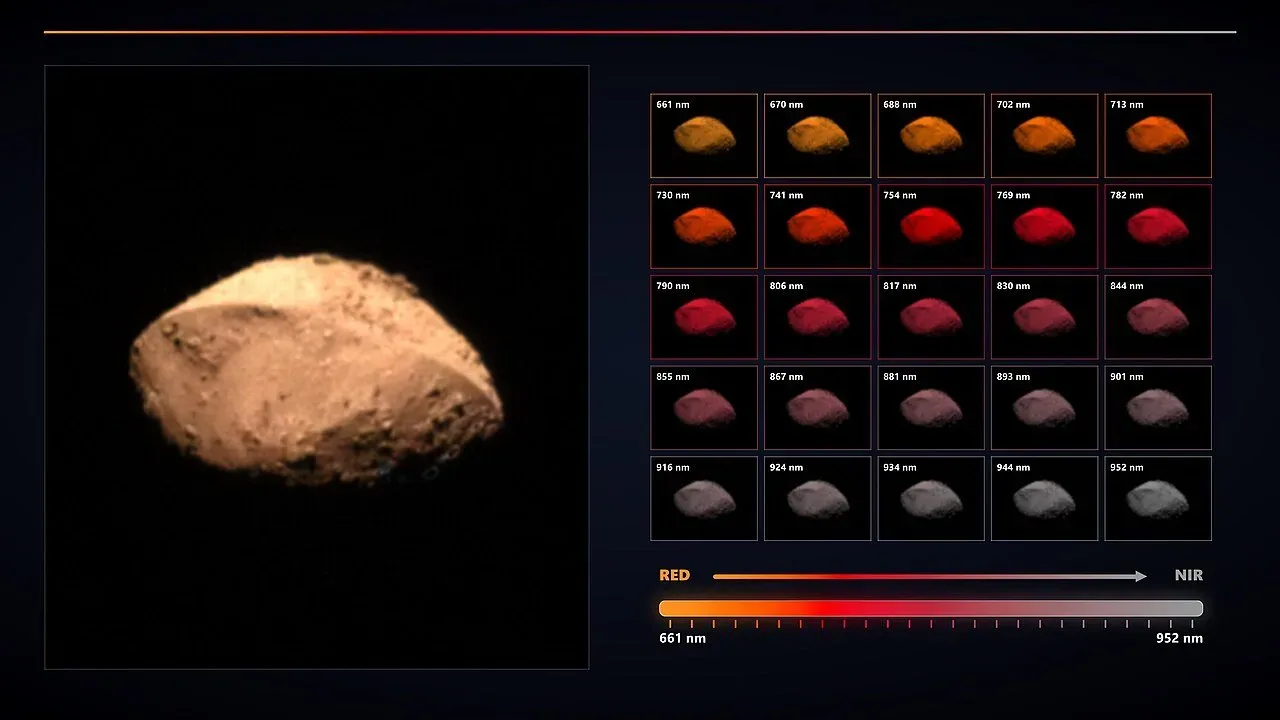
Hera is a European Space Agency spacecraft that reached the Didymos asteroid system in November 2026. It is surveying Didymos and its moonlet Dimorphos to find out what NASA's 2022 DART impact changed, including any crater, the moonlet's structure and its mass.
Table of contents 6 sections
- ESA said on 11 November that Hera has reached the Didymos system and started an early characterisation phase.
- Hera flies rectangular orbits at about 12 centimetres per second, so a failed thruster burn sends it away from the asteroids.
- NASA's DART hit Dimorphos on 26 September 2022 and shortened its orbit by about 33 minutes.
- ESA is scheduled to move Hera closer next month, with two CubeSats and landing operations planned later.
The European Space Agency's Hera spacecraft has reached the Didymos asteroid system, and on 11 November ESA said it had begun an "early characterisation phase" about 25 to 30 kilometres from the two rocks. The Hera spacecraft Didymos visit is meant to answer a question left open since 26 September 2022, when NASA's DART probe deliberately hit the small moonlet Dimorphos: what did that collision actually do to it?
What is the Hera spacecraft Didymos survey doing right now?
For now, the Hera spacecraft is looking at the whole Didymos system rather than any one spot. According to ESA's account, the goal of this phase is to collect the big-picture findings that support the mission's planetary defence aims. Mission scientist Michael Kueppers is quoted by ESA saying, "Our aim right now is to gather the big-picture findings of relevance to supporting the mission's planetary defence goals."
The targets are a pair. Didymos is about 780 metres across, and ESA puts its gravity at roughly 40,000 times weaker than Earth's. Dimorphos, the 151-metre moonlet that orbits it, has gravity roughly 200,000 times weaker. At those strengths, almost anything loose on the surface behaves very differently from rocks on Earth, which is part of why scientists want a close look at the crash site.
Why does Hera fly in rectangles?
The Hera spacecraft does not circle the asteroids the way most orbiters circle a planet. It moves around the two bodies' shared centre of gravity at about 12 centimetres per second, travelling in nearly straight lines. Every three days, then every four, its thrusters fire to turn the course by 90 degrees, which traces out what ESA calls rectangular orbits.
The design borrows from experience with ESA's Rosetta comet mission, and it has a safety logic. ESA says that if a thruster firing fails, the spacecraft drifts away from the asteroids rather than toward them. Each manoeuvre also uses only a tiny amount of propellant. When your targets have almost no gravity to hold you in place, a gentle, forgiving trajectory is the cautious choice.
What did the DART impact change, and what is still unknown?
DART was a 580-kilogram NASA spacecraft that struck Dimorphos at 6.1 kilometres per second on 26 September 2022. ESA says the impact sent a debris plume across 10,000 kilometres and shortened the moonlet's orbit around Didymos by about 33 minutes. That shift was the headline result of the DART experiment.
The gaps are in the details. ESA lists the crater or structural changes caused by the impact, Dimorphos's composition, its internal structure and its mass as things still to be established. It also says scientists want to understand why the deflection was larger than impact simulations suggested. Those questions matter because anyone planning to redirect a real asteroid someday needs to know how much push a given impact delivers, and that depends on what the target is made of.
A summary of the ESA material on ScienceDaily adds that the researchers do not yet know whether the impact dug a crater or reshaped the asteroid as a whole. Hera's instruments are supposed to settle that, with a focus on Dimorphos.
How is ESA flying and tracking a craft 196.5 million kilometres away?
Flight control runs from ESOC, ESA's operations centre in Darmstadt, Germany. The team talks to Hera about eight hours a day across a distance of 196.5 million kilometres, using four 35-metre Deep Space Antennas in Argentina, Spain and Australia. ESA's Flight Dynamics team takes the telemetry, works out exactly where the spacecraft is and calculates the commands that place it at its next point.
That workload explains the slow pace. With thruster burns spaced three and four days apart, the plan is a steady series of long legs rather than quick darts around the asteroids. The Hera spacecraft Didymos survey is closer to careful surveying than to a fly-by, and the images and measurements gathered from tens of kilometres away give the team a map to plan the closer work.
What comes next for the Hera spacecraft at Didymos?
ESA says that next month Hera is scheduled to move closer for a "detailed characterisation phase". That means flying more complex bowtie-shaped hyperbolic arcs, starting from about 20 kilometres away. Over the coming months the spacecraft is also to carry out a close-up investigation of the crash site on Dimorphos with its multiple instruments, deploy a pair of shoebox-sized CubeSats for a closer survey, and eventually progress to landing. ESA's page gives no exact dates for those later steps, so treat the schedule as approximate until the agency publishes one.
The mission sits in a busy stretch for deep-space work. NASA's Perseverance rover recently set a driving distance record, which we covered in our report on the Perseverance record, and Hera adds a European follow-up to NASA's impact test.
What should readers watch for?
For the Hera spacecraft Didymos mission, the next marker is the move into the closer phase in December, when Hera should begin returning sharper views of Dimorphos. The result to look for is a clear answer on whether the impact left a crater, how the moonlet's structure holds together, and what its mass turns out to be. Those figures would let scientists test their models against a real impact result instead of a simulation, and the explanation for the larger than expected deflection will be the part most worth following.
Frequently asked
- Hera spacecraft in rectangular orbit around target asteroids — European Space Agency
- Hera reaches the site of NASA's 2022 DART asteroid impact — ScienceDaily

0 comments
No comments yet — be the first.