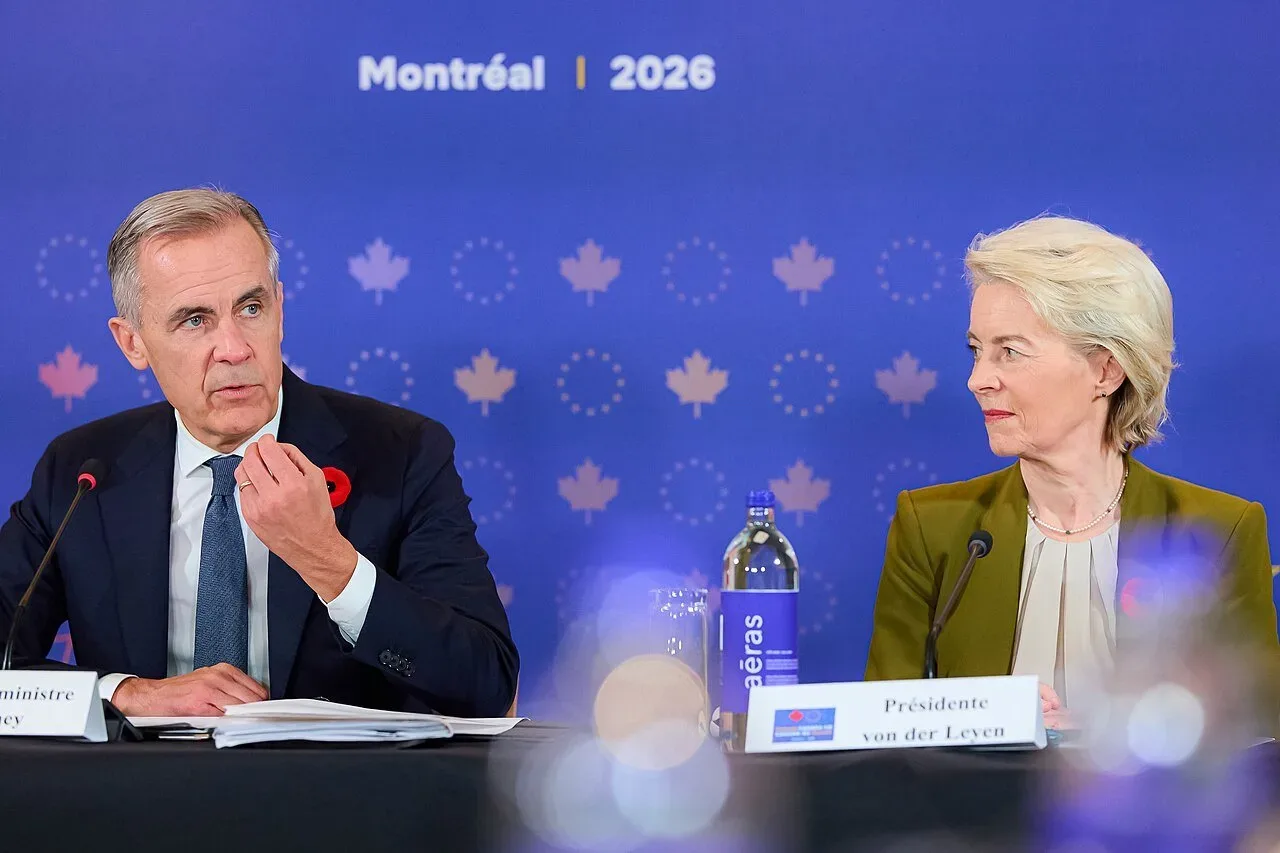
Canada and EU leaders said at their 29-30 October 2026 Montreal summit that they want Canada to become the EU's first associate member, described by Ursula von der Leyen as "association without accession." It would deepen trade, security and research ties without full membership, with talks due in spring 2027.
Table of contents 6 sections
- Carney, von der Leyen and Costa said in Montreal they want Canada to become an EU associate member.
- Von der Leyen called it "association without accession," and no formal definition exists yet.
- The summit produced a digital trade agreement and a Canadian contribution of 500 million euros to a Ukraine support fund.
- Germany's ambassador said Berlin was "a little surprised" and has concerns about the label.
- Carney hopes to confirm terms at EU council meetings in June after talks in the spring.
Canada and the European Union want Canada to become the bloc's first "associate member," Prime Minister Mark Carney and EU leaders said at a two-day summit in Montreal that ended on Friday 30 October. The Canada EU associate member idea stops short of joining the EU, and its terms are not written yet, but it is the most ambitious step in the relationship since the CETA trade agreement.
European Commission President Ursula von der Leyen called it "association without accession." Canada cannot become a full member because of geography, she said, but "we can replace the term accession with a common ambition and vision," according to CP24.
What Canada EU associate member status would mean
Nobody has published a definition, and that is the honest starting point. What the leaders described is a set of deeper ties in security, digital trade, research and education that would sit on top of CETA, without full EU membership.
Carney played down the label. He said "the nomenclature doesn't matter" and that affordability matters more to Canadians. European Council President António Costa invited Carney to attend EU council meetings in June, where Carney hopes to confirm the terms. Negotiations are set to continue in the spring, and EU officials had expected the concept to be ready for endorsement at the next Canada-EU summit next year.
What was actually signed in Montreal
The summit produced concrete pieces even while the headline idea stays vague:
- A Canada-EU Host Country Agreement, signed by Foreign Minister Anita Anand and EU foreign policy chief Kaja Kallas.
- A digital trade agreement, which Costa described as a "CETA for a digital world."
- A joint statement on deeper security, digital and education ties, including talks on expanding Erasmus+ student exchanges and a joint feasibility study on Canadian liquefied natural gas exports to Europe.
- A Canadian contribution of 500 million euros to Europe's 90-billion-euro support fund for Ukraine.
- Plans to bring Canada into Europe's network of 12 supercomputers and to let the European Investment Bank back Canadian critical minerals projects.
Ottawa also announced an investment of up to $1.6 billion in the Canadian AI company Cohere during the summit. For a sense of the rules Canadian tech firms would be aligning with in Europe, see our EU AI Act explainer.
Why Germany is uneasy
Not every EU government is on board with the wording. Germany's ambassador to Canada, Matthias Luttenberg, said Berlin was "a little surprised by the announcement." His concern is that Germany uses "associated membership" language for its approach to countries such as Ukraine, which are on a path toward joining. CTV News reported that the term did not appear in the draft summit statement.
This matters because any new arrangement needs approval from EU member states, and Carney has said Canada's Parliament would also debate and vote on it. A term that sounds like a halfway house to membership is harder to sell in capitals worried about the Ukraine accession process.
The economic case, and its limits
The numbers explain Ottawa's interest. A TD Bank report says there could be demand for nearly $60 billion in additional Canadian goods exports to the EU, and that energy exports could rise by roughly $50 billion under certain conditions. Today Canada accounts for only about 1 percent of EU imports of goods and services.
There are friction points. The federal government has assessed that the EU's Carbon Border Adjustment Mechanism could affect up to $2.8 billion in Canadian exports, according to the Conservatives, and negotiators are working on "common solutions" for that levy and the EU's deforestation rules. CETA itself has still not been ratified by 10 of the 27 member states, according to a Carleton University tracker cited by Conservative leader Pierre Poilievre.
That last point is the strongest argument from sceptics. If more than a third of EU members have not ratified a trade deal signed years ago, a new and broader association will not move quickly.
Criticism at home
Poilievre called the summit a "grand theatrical meeting" and urged Carney to focus on the cost of living and on getting every EU member to ratify CETA. Quebec Premier Paul St-Pierre Plamondon skipped the summit in his own province, saying Quebec had been shut out of the discussions.
The summit came a day after Carney launched the Plan for a Stronger Canada, which the Prime Minister's Office describes as Canada's first national security strategy in more than 20 years. Read together, the two announcements show a government trying to spread its security and trade bets beyond the United States.
What to watch next
The next markers are spring negotiations, Carney's appearance at EU council meetings in June and whether Germany and other members accept the "associate" label or push for different wording. Canadian students and researchers should watch the Erasmus+ and Horizon Europe talks, since those could deliver practical benefits well before any grand title is agreed.
Frequently asked
- Prime Minister Carney launches The Plan for a Stronger Canada — Prime Minister of Canada
- Canada 'associate member' status with EU under negotiation — CP24 / The Canadian Press

0 comments
No comments yet — be the first.